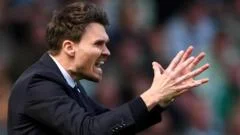
In a remarkable turn of events, the iconic Dutch footballer Edgar Davids, renowned for his illustrious career at clubs like Ajax, Juventus, and Barcelona, took the reins at Barnet FC in 2012 as the player-head coach. At that time, the club was perilously positioned at the bottom of the Football League, marked by a string of losses that made his appointment even more perplexing. This wasn't just any managerial debut; it was the beginning of a fascinating chapter in Davids' career that blended playing and coaching.
The circumstances leading to Davids' arrival raise an intriguing question: why would such an esteemed player, with 74 caps for the Netherlands and a storied club history, choose to join a struggling side like Barnet? After retiring briefly in 2010, Davids found himself living in London and playing in Sunday League matches by 2012. The situation arrived when Barnet's chairman, Anthony Kleanthous, saw an opportunity. “He was aiming to secure his coaching badges,” Kleanthous explained, “and we thought partnering with a well-known figure like Davids could benefit both parties.” Remarkably, Davids accepted the role without demanding wages, shifting expectations for what a player-coach dynamic could be.
Players at Barnet were left in disbelief when news broke of Davids’ managerial position. “There was speculation that morning, and everyone dismissed it as a joke,” recalls striker Jake Hyde. Yet, on October 12, 2012, the reality set in: Davids was officially named a joint head coach. Hyde, who ended up as the team's top scorer under Davids, noted that his desire to both coach and play spoke volumes about his love for the game. “If he truly wanted to be a manager, he probably would’ve chosen a higher-profile club first. It seems like he just loved to play.”
Two Captains, One Ship
Davids shared managerial duties with Mark Robson, who had already encountered considerable struggles in his own short tenure—his team had yet to secure a win in 13 games. Under their partnership, Barnet faced significant hurdles, finding themselves five points adrift in League Two. Adding to the complexity, Davids brought in his childhood friend, Ulrich Landvreugd, as his assistant, signaling that he was ready to make his mark even as a newcomer to the managerial side of the sport.
Their debut together saw Davids captaining the team in a defeat to Plymouth, but soon after, they turned things around with a stunning 4-0 victory over Northampton, where Davids shone as a standout performer. Paul Fairclough, then the director of football, likened his impact to “rolling the clock back” to the highlights of Davids' prime. However, the dual leadership model proved uneasy, inherently inviting tensions. Fairclough articulated a truth about football management: the presence of dual leaders often breeds conflict. “Davids’ larger-than-life persona began to eclipse Robson, who was understandably uncomfortable being overshadowed,” he remarked.
The inevitable friction prompted Davids to confront Kleanthous about the partnership. He wanted clarity: either Robson remained or he did. The chairman chose to back the former football star, leading to Robson's exit and Davids stepping up as the sole head coach by the end of December.
Establishing Authority
From the outset, Davids aimed to establish authority and respect among his players, insisting they refer to him either as "Sir" or "Mister," akin to a command found in Italian football. The enforced formality resulted in a mix of amusement and confusion among players. Hyde recounted how the new regime felt more like school than a football team, stating, “When Davids had the ball, no one wanted to be the first to call for it—‘Mister’ just had that kind of presence.”
Just as he demanded respect, he also brought a fierce competitive spirit. Hyde observed that Davids celebrated training goals as if they were match-winners, a revealing glimpse into his mentality: he wanted to win every drill, regardless of the stakes. The intensity was palpable, and his passion for the game resonated throughout the team, for better or worse. As assistant manager Landvreugd noted, Davids aimed to instill a new culture at Barnet—one that demanded nothing short of 110% effort.
Davids' approach combined an unwavering commitment to excellence with a palpable enthusiasm for playing, a duality that shaped his time at Barnet and still evokes fond memories among fans today.
Lessons from the Edgar Davids Era at Barnet
Reflecting on Edgar Davids' tenure at Barnet reveals a complex interplay of ambition, frustration, and ultimately, disillusionment. The initial spark he brought to the club was palpable; his arrival transformed a struggling side into a unit that fought tooth and nail, as Jake Hyde recalls, "We all go to war together." Such camaraderie is often what separates good teams from great ones. Davids not only instilled a fighting spirit but also catalyzed personal growth for players like Hyde, who attributed his career advancement largely to Davids’ management style.
However, the road was not without its bumps. While Davids had the tactical acumen and a clear vision for improvement—pushing to secure at least 50 points to avoid relegation—his on-field antics often overshadowed his management credentials. Players reported that the atmosphere shifted dramatically when Davids faced off with others in the league. Hyde mentioned the divisive impact Davids' approach had within the changing room, pointing out the strong sense of unity that formed not just from triumphs but from confronting a common adversary in their manager.
The Rollercoaster of Expectations
For a coach of his stature, the reality of team sports is often harsher than anticipated. Despite the promise of winning seasons and the prospect of promotions swirling around Davids’ arrival, the narrative veered dramatically off course during his second season. The club spiraled into the Conference, where ambition clashed with the stark realities of lower-league football. Kleanthous believed that had they managed to stay up, they might have had several good years, hinting at the lost potential under Davids’ headship.
Yet, the most troubling aspect of Davids’ leadership came from his growing detachment. Reports surfaced about missed away games, leading to speculation regarding his commitment. The line between manager and player became increasingly blurred—an untenable situation for a club needing steadfast leadership. As Hyde pointedly noted, a manager who repeatedly misses games is a scenario that simply doesn’t fit the professional landscape of football.
Concluding Thoughts
Edgar Davids’ chapter at Barnet stands as a case study in the challenges of melding talent with management prowess. While his impact initially inspired a beleaguered team, the eventual unraveling signals a crucial lesson: passion alone doesn’t guarantee success. As for Davids’ legacy, it is bittersweet—marked by a promise of revival that curdled into an era of confusion and missed opportunities. He may continue to support Barnet from afar, but one can’t help but wonder how different the outcomes might have been with a firmer commitment to leadership on and off the pitch. As observers of this remarkable story, if we take away anything, it's that success in football hinges on coherent vision as much as raw talent.