
Getty Images
Few broadcasters have shaped the industry as consistently as the BBC. For more than a century it has invented technologies, tested new formats and built a reputation for engineering and programming that rivals still measure themselves against.
Much of that comes from a research and development team whose job is to spot promising ideas and turn them into something the corporation can use. Sometimes that means a cheaper way to transmit a signal. Sometimes it means a product that changes how people watch television or sport.
The point isn't novelty for its own sake. The BBC is funded by the universal licence fee, which means every experiment ultimately has to deliver something tangible for the British public who pay for it.
Prototyping what comes next
Eleni Sharp, head of product at BBC Research and Development, says the team's starting point is people rather than kit. "We're really focused on how we use new technology and how it will impact audiences," she tells SportsPro. The group tracks audience trends and behaviour, works with content brands both inside and outside the BBC, and tries to imagine, prototype and develop whatever might come next.
The technology itself changes with the times. A few years ago the headline was extended reality. Now it's artificial intelligence, and the job is to work out what AI means for the BBC and how it can be put to use. Sharp is also blunt about where the team's attention sits: "We also obsess about audience behaviour and look at how audiences are using technology [and] what the behavioural trends are."
Standards, rivals and the licence fee debate
The impact of this work doesn't stop at the BBC's own doors. Its investments have raised standards across the industry and opened new markets that commercial rivals have been quick to exploit. Its early push into streaming and podcasts helped make both mainstream among British consumers, and much of what it learns gets shared through standards bodies, conferences and academic papers.
Not everyone is thrilled about this. Parts of the media sector accuse the BBC of mission creep and argue that the licence fee hands it an unfair advantage. And yet the counterargument has weight: that public funding stimulates the broadcasting ecosystem both directly and indirectly, in the UK and beyond. Whether you find that convincing probably depends on whether you're a licence fee payer or a competitor.
AI moves from experiment to daily tool
AI now sits at the top of Sharp's agenda, and the reasons are practical. The BBC wants to attract and serve audiences in an era of almost unlimited choice, and it wants to find backend efficiencies that give licence fee payers more for their money.
Sharp is most enthusiastic about the speed. "[AI] is able to fast-track a lot of the things that we want to do," she says. Editorial teams can re-version content quickly, and tasks like transcription and translation, which once consumed large chunks of journalists' time, now take so little effort that staff can focus elsewhere and offer audiences more services.
The creative side has gone faster too. Teams can prototype and build quicker than ever and put something in front of audiences for trial. Scaling it is another matter. Rolling a tool out at full volume, across multiple devices, takes considerably longer. That gap between a working prototype and a finished service is where many promising projects slow down, and Sharp doesn't pretend otherwise.
Still, the ability to test and validate ideas faster is a real shift. "It's a brilliant time to work in research and development," she says. That enthusiasm is easy to share when you're the one building things. It's harder to judge from the outside until the tools reach viewers at scale.
Signals and the second screen
Personalisation has become close to a requirement in sport. Rights holders and broadcasters want to maximise engagement and revenue, and data-driven algorithms are the usual way to tailor the experience for each user and keep them inside a particular digital environment.
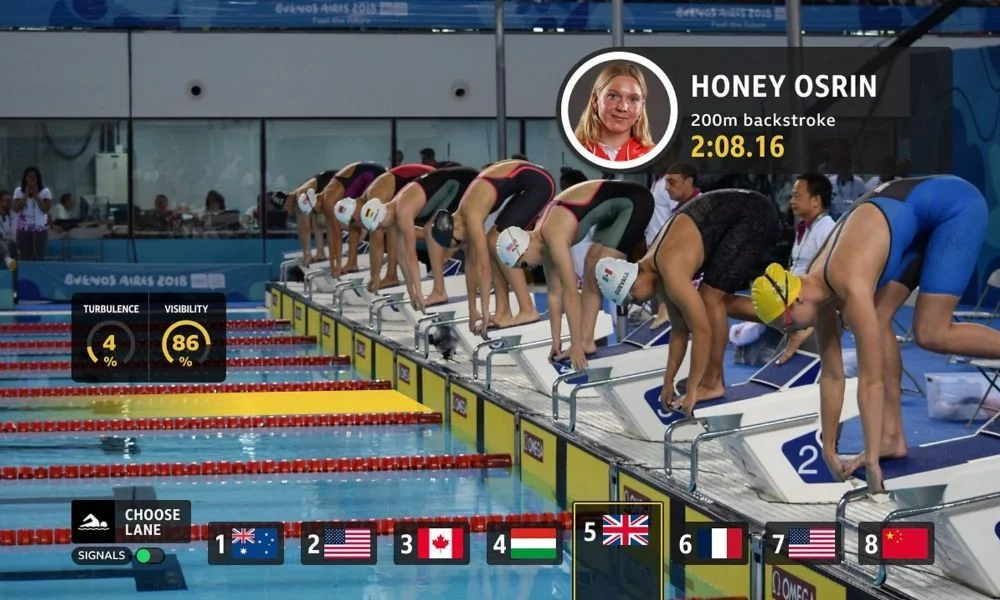
The BBC's answer is a platform it calls Signals. It lets broadcasters layer real-time data, AI, commerce and gamification on top of a live video feed, adjusting the experience for individual viewers. In effect, it merges the first and second screen. Instead of pulling out a phone to check stats or betting markets, the viewer gets that information alongside the match, which keeps their attention where the rights holder wants it.
The commercial logic is straightforward. Deeper engagement strengthens fan relationships and increases watch time. It also plugs what the BBC's framing calls value leaks: the revenue that drifts to a social platform or mobile app that didn't pay for the rights and didn't invest in the audience. Keeping that engagement inside the broadcaster's own product means the rights holder captures the benefit.
The underlying idea isn't new. Object-based broadcasting, where separate video, audio and graphics feeds are transmitted in modular form and reassembled according to each viewer's preferences, has been tested many times. What's changed is that digital distribution and embedded intelligence are making it practical. It's not entirely clear yet how much control viewers actually want over their feeds, though. That's the question Signals will have to answer once it moves beyond prototype.
Centre Court as a live testbed
Every live BBC broadcast from Centre Court at this year's Wimbledon ran with Signals switched on. That's a serious stress test, not a pilot tucked away on a side channel. The layers sat on top of the feed: data graphics showing player dominance and serve speed, animations marking record-breaking moments, and two-way quizzes built by BBC editorial teams.
Here's where it gets interesting. Sharp thinks this interactivity could eventually shape the questions asked in post-match interviews, so the data layer starts talking back to the sport itself. A voice-activated AI assistant, also built for the tournament and trained on tennis and Wimbledon data, could push personalisation further. Other AI applications could follow.
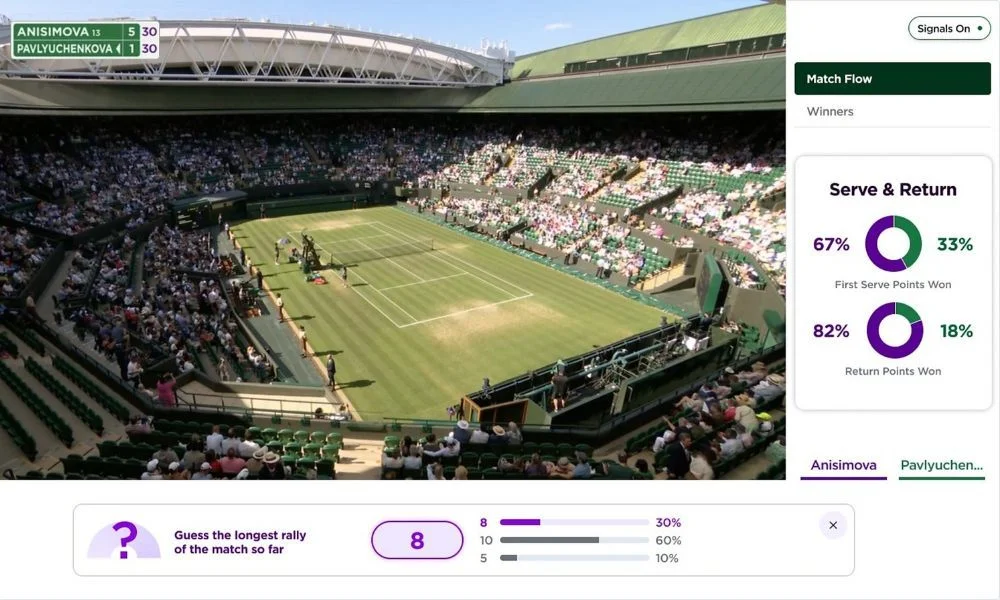
Signals was tested extensively during the 2026 Wimbledon Championships (Image credit: BBC)
The numbers, and what they leave out
The audience figures are the strongest case for Sharp's argument. Viewers spent an average of 30 minutes and four seconds with the feature, which she said was more than the BBC expected. Three in four viewers, 75 per cent, kept Signals enabled even when they could switch it off.
That second number matters more to me than the first. Anyone can try a novelty feature once. Keeping it on when the off switch is one tap away is a clearer signal of real value.
Still, the headline figures don't answer the harder questions. How did engagement hold up across the whole tournament? Were the viewers who stayed on already the most devoted fans? Those aren't addressed here, and I'd want answers before calling this a template for anyone else.
Beyond tennis
Sharp says football, athletics, cricket and motorsport are "all really obvious fits." Player cards, key moments and race statistics can carry over, and the interface can adapt to whatever sport it's covering. Other ideas include letting viewers turn the commentator on or off, choosing a different commentator, and switching camera views. "There are so many options," she says. That's the line I'd treat with the most caution. Options are cheap to list. Making them useful is the expensive part.
The roadmap goes further. Some AI companion features are already rolling out. Commerce is on the list, including retail, exclusive offers and sponsorship takeovers. So is immersive work: voice, 3D and multi-camera capabilities. And sport isn't the only target. Sharp points to entertainment and live music programming, citing The Traitors and Glastonbury as examples.
From public broadcaster to technology vendor
The BBC isn't planning to publish its findings in a journal or on an external blog and leave it there. It intends to license Signals to other broadcasters wrestling with the same problems. Sharp's pitch is simple: "there's no need to plug [technologies] from multiple vendors to get the solution we all want." Signals is built as white-label technology, so partners can license it and work with the BBC on it. Sharp says the corporation already works with more supporting partners and rights holders on the project.
Some critics will find that shift uncomfortable. The logic still holds up. Commercialising broadcast innovation can justify the original investment, spread the benefits of the work more widely and create a revenue stream at a time when the BBC's funding is under constant pressure.
Reith's shadow
The BBC worked out sports broadcasting conventions largely for itself in the 1920s. Now it wants to redefine sports viewing for an AI-first era, and the irony is hard to miss.
Lord Reith, the BBC's first director general in 1923, did not believe viewers should influence what the corporation transmitted. He saw it as the broadcaster's job to tell the public what it wanted, not the other way round, and he insisted a public service broadcaster needed to be a monopoly.
More than a century later, the BBC is letting audiences watch what they want, however they want, wherever they want. It's also helping its competitors do the same. Sharp's hope is that Signals becomes "the leading format for audience engagement, turning passive viewing into personalised, measurable and intelligent experiences." If that happens, Reith's model will look like the outlier, and the BBC will have turned its own rulebook into a product it sells.


