Translated by José M. Hernández Lagunes
The most useful lessons from the 2026 Milwaukee Brewers may be the ones other clubs can see without access to private tracking data or player development plans. Their success invites plenty of theories about bunting, contact hitting, low payrolls and managerial skill. Some may prove right. But broad conclusions drawn from a winning season can obscure what the team actually did well. Two visible features offer a firmer starting point: the physical mechanics behind Jacob Misiorowski’s fastball and an offense that swung less often than any other team in baseball.
That distinction matters because successful teams are routinely treated as templates. Clubs do study the best organizations, but imitation isn’t as simple as copying a lineup choice or a public strategy. A practice that works for Milwaukee may depend on player traits, coaching or information outsiders can’t see. Here, the evidence supports a narrower question: what elements of the Brewers’ play are specific enough to study, and visible enough for other teams to try to reproduce?
Misiorowski’s velocity comes with a distinctive delivery
Start with Misiorowski, whose fastball speed is only part of the story. Baseball is full of pitchers who can throw at 100 miles per hour. Far fewer create the same combination of speed and physical explosiveness. Misiorowski drives down the mound with unusual force, covering more ground from his back leg and releasing the ball closer to the hitter. The result is a pitch that arrives quickly and a delivery that can make its timing harder to read.
A comparison of pitchers who each threw at least 20 pitches above 100 mph in 2026 helps show the difference. Among the 51 pitchers who met that threshold, Misiorowski had the greatest average release extension on those pitches. His extension is set against Robert Suárez, in the top quartile; Bubba Chandler, around the median; Jordan Hicks, in the bottom quartile; and Joel Peguero, at the bottom.
The comparison uses images captured from the open side, at roughly the same point just before foot contact. Misiorowski’s posture stands apart. He gets lower and farther down the mound off his back leg, then lands with his front knee well behind his foot. Those details suggest that his lower half contributes more of the force behind the pitch. A pitcher who relies less on that kind of drive may have to work harder with the arm to reach similar velocity, while giving the hitter a different view of the ball’s path to the plate.
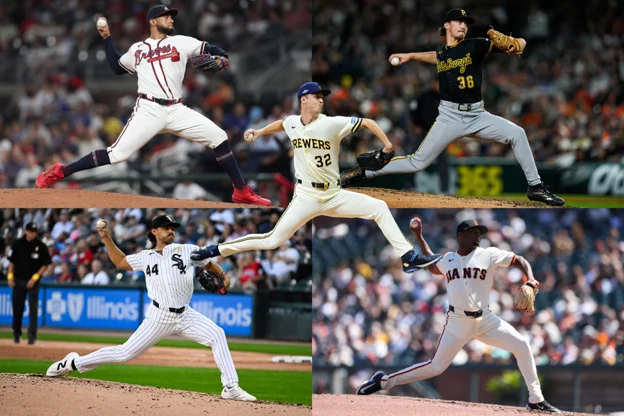
That doesn’t mean a club can manufacture another Misiorowski on demand. His particular combination of size, athleticism and skill may be rare. But teams could still study which parts of his movement are teachable and look for pitchers capable of a similar version. The likely result would be a range of outcomes, with many attempts falling short of the original. Even so, the delivery may become an influence on how young pitchers train their lower bodies and use them in games.
My read is that this could outlast any one result from the Brewers’ season. A championship can draw attention to a team, but the mechanics are available to watch and compare. Coaches and players have a concrete model to examine, even if the public can’t see the club’s internal development technology or know exactly how it teaches the movement. The challenge for imitators will be to identify what can transfer without treating Misiorowski’s delivery as a trick that works for everyone.
Milwaukee’s offense found value by swinging less
The other visible lesson sits at the plate. Milwaukee recorded the lowest swing rate in the league for a second consecutive season. That approach sounds passive, and it can become a weakness if hitters allow pitchers to fill the strike zone. The Brewers’ results suggest a more measured interpretation: selectivity can contribute to a productive offense when players know which pitches to attack and still swing often enough to keep pitchers from exploiting their restraint.
In 2026, the Brewers gained 280 runs on pitches they didn’t swing at and lost 205 on pitches they did swing at. Those figures don’t make Milwaukee uniquely good at taking pitches. Across the league, teams generally gained value when they held back and lost value when they swung. The difference is that the Brewers found a way to build an offensive approach around that tradeoff more effectively than their reputation or collection of individual hitters might have led observers to expect.
There’s an important limit to the lesson. No team can simply refuse to swing and expect pitchers to keep missing the zone. Major-league pitchers can respond by throwing strikes, and hitters still need to punish enough of those pitches to keep the defense honest. Milwaukee’s approach appears to depend on discretion: take when the pitch doesn’t warrant a swing, and make the occasional swing count. That may be less thrilling than a power-first attack, but it can create value in small increments.
For other clubs, the question isn’t whether taking pitches is good in the abstract. The Brewers’ own run totals show that taking and swinging each have costs and benefits. The practical question is whether a particular roster has hitters who can be selective without surrendering the strike zone. Milwaukee seems to have found that balance. Its offense produced more than a simple tally of star power might suggest, in part because it avoided swinging at so many pitches.
Imitation will depend on the players
These two examples point to different kinds of copycat behavior. A pitcher’s delivery can inspire changes in training, though the physical demands may limit how many players can reproduce it. A low-swing offense is a team-wide choice, but its success depends on the hitters’ judgment and the ability to respond when pitchers challenge them. Neither idea offers an easy recipe, and neither proves that every feature of Milwaukee’s success can be explained from the outside.
That’s why simple post-season lessons can mislead. The Brewers may also have benefited from coaching, player development, workload management and other factors that outsiders can’t assess reliably. Without access to sound evidence on those subjects, confident explanations risk turning the outcome into a story that fits the commentator’s preferred theory. The observable details are more modest, but they’re also more useful: study how Misiorowski generates extension, and examine how Milwaukee’s hitters decide when to swing.
Other teams will keep looking for ways to copy winners. The Brewers’ clearest examples suggest that imitation works best when it begins with a specific skill or decision and asks whether the roster can support it. A few clubs may develop pitchers who borrow from Misiorowski’s movement; others may find that patience at the plate improves their at-bats. The takeaway is less about reproducing Milwaukee wholesale than about identifying the mechanics and choices that make its approach work.
The post Lo que verdaderamente podemos aprender de los Cerveceros–primera parte appeared first on Baseball Prospectus.


