Jordan Walker’s 2026 season made a strong case for patience with young hitters whose power remains visible even when the results disappear. Drafted at an average pick of 359.2 in NFBC leagues, the St. Louis Cardinals outfielder finished as the No. 10 player on FanGraphs’ dollar value Player Rater. His season paired elite contact force with a more effective swing and an unexpected 22 stolen bases.
A low-cost bet after two difficult seasons
The skepticism was understandable. Across 2024 and 2025, Walker hit .211/.270/.324 over 162 games, striking out 30.7% of the time. The Cardinals sent him to Triple-A Memphis in both seasons to reset and work on his swing, but the minor league results offered little reassurance. His struggles followed him back to the majors.
There was still a reason to believe the damage could improve: Walker kept hitting the ball hard. In 2025, he ranked in the 87th percentile for hard-hit rate, the 66th for barrel rate and the 91st for average exit velocity. The problem was making contact often enough to turn that force into production. His strikeout rate climbed to a career-high 31.8%, while a 47.5% ground-ball rate and just an 11.3% pulled fly-ball rate limited his chances to do damage in the air.
Walker spent the offseason working at Driveline Baseball, focusing on keeping his right hip back. The goal was to improve his balance and avoid giving away some of the raw power in his swing. The work didn’t produce instant results in spring training: he went 6-for-28 (.214) without an extra-base hit in his first 10 Grapefruit League games, with two walks and 11 strikeouts.
St. Louis responded by sitting him for three days so he could work in the batting cages. Manager Óliver Mármol continued to back him, pointing to the attention Walker was giving his preparation. “We’re excited about the work he’s doing, the attention to detail, and that hasn’t changed,” Mármol told SI.com. “You stay focused on those things because, eventually, they’re what will get him where he needs to go.”
The adjustment showed up in the results
Walker reached base four times and homered across his final two spring games, then carried that momentum into the regular season. He posted a 1.116 OPS with eight home runs over his first 16 games. By the end of May, he was hitting .290/.357/.551 with 15 home runs, 43 RBIs and a 24.4% strikeout rate.
Walker and Mármol pointed to better communication with the coaching staff as one reason for the progress. Walker said the club used data on his body movement to identify when he felt comfortable at the plate and when his swing felt off. “When I see the data, I can talk about it, and then we can try to speak in their terms,” he said during the final week of the season in an MLB.com interview.
The season’s most visible moment came in July, when Walker won the Home Run Derby by rallying past Kyle Schwarber in the final at Schwarber’s home park. A second-half slump prompted speculation about a Derby hangover, but Walker’s .305/.348/.505 line and five home runs in August cut against that explanation. Research on the so-called Home Run Derby curse has found little support for the idea.
September was a real downturn: Walker hit .172/.232/.287 with two home runs and a 36.8% strikeout rate. The Cardinals later said he had been dealing with hip discomfort late in the season. A first full major league campaign can also bring ordinary wear, particularly for a young hitter who has become a central part of opponents’ scouting plans.
Power built on swing speed
Walker may never become the high-fly-ball hitter the Cardinals initially hoped to develop. The more useful sign is that he began to lift the ball more often without losing the hard contact that makes his bat dangerous. In 2026, his ground-ball rate fell to 42.8%, below the league average, while his pulled fly-ball rate reached 15.9%.
His contact quality remained exceptional: a 49.9% hard-hit rate, a 13.2% barrel rate and a 92.6 mph average exit velocity each placed him at or above the 90th percentile. Walker also recorded baseball’s second-fastest average swing speed, at 79.3 mph, behind Junior Caminero. His fast-swing rate—the share of swings reaching at least 75 mph—led the majors.
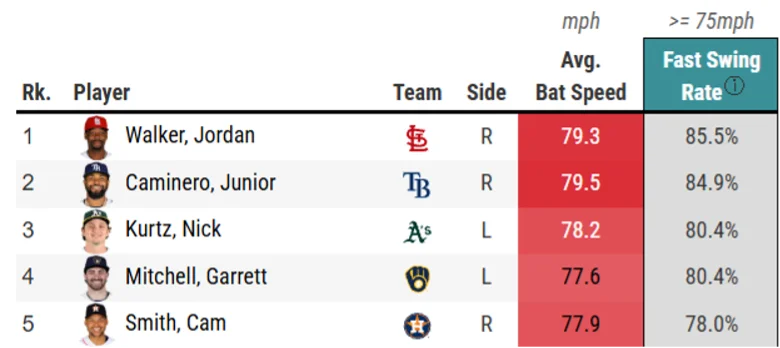
From 2024 through 2025, 76.2% of Walker’s swings met that fast-swing threshold. In 2026, the figure rose to 85.5%. That jump looks like more than a mechanical detail: it fits the broader picture of a hitter who regained comfort in the box and could let his powerful swing go with greater conviction.
Speed adds another dimension
Walker’s 22 steals, with only five times caught, were nearly as surprising as his power rebound. He finished one home run short of joining the small group of players to record at least 30 homers and 20 steals. The running game makes sense in retrospect: once he reached base regularly, he had more opportunities to use his speed. At 6-foot-6 and 250 pounds, Walker looks built for a different game, but he has always moved well and ranked in the 91st percentile in sprint speed in 2026.
The risks remain visible
Busch Stadium III puts a ceiling on Walker’s home-run outlook. Over the previous three seasons, only Pittsburgh’s PNC Park had been less favorable for home runs by right-handed hitters. Walker’s 2026 split reflected that challenge: he hit 19 home runs on the road and 10 at home.
The Cardinals’ supporting lineup is another concern. Its 93 wRC+ placed it in the bottom third of the majors, and the club may not make major additions in free agency during the winter. That could leave Walker with limited help around him. Still, the lineup’s weakness didn’t prevent him from compiling strong totals this season.
What Walker’s season means for drafts
The case for Walker is a reminder not to give up too quickly on a once highly regarded prospect who is still young and continues to hit the ball hard. He’ll turn 25 in May, and his 2026 results show how much a change in feel at the plate can matter when the raw power was already there.
His next fantasy draft price will be far higher than his 359.2 ADP last spring, so the same bargain won’t be available. I’d still consider him at a premium price, with one condition to watch: his strikeout rate needs to start with a two, not a three. If he keeps the swing speed and contact quality while holding that line, Walker’s 2026 breakout can carry into his next season.
The post Revelación de valor ’26: Jordan Walker appeared first on Baseball Prospectus.


