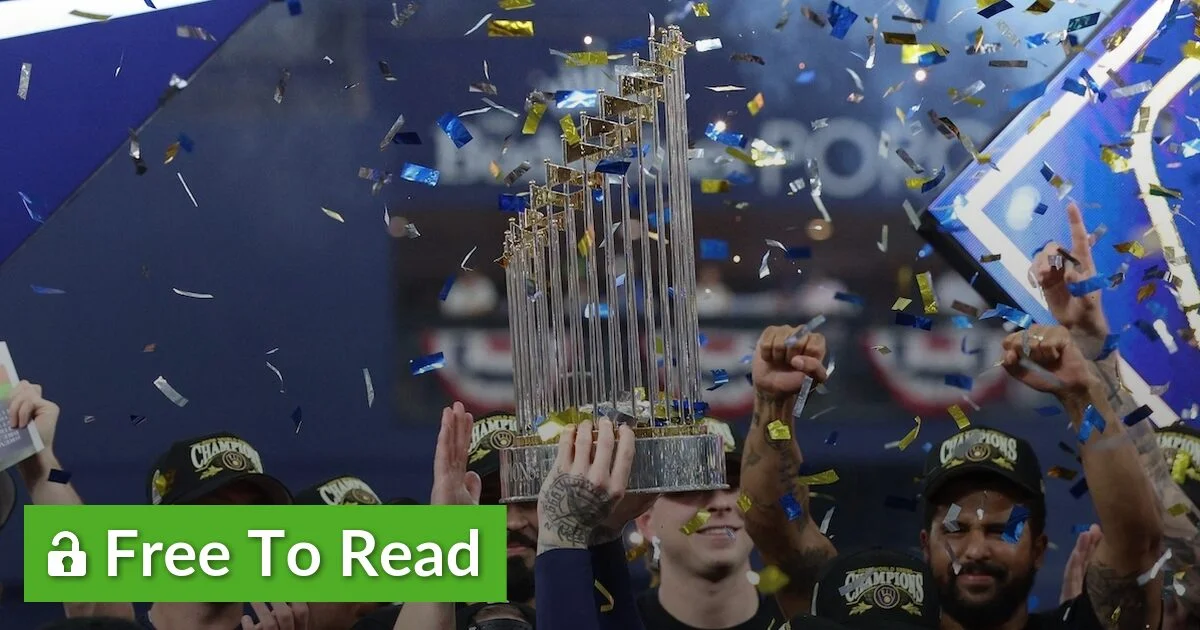
The Milwaukee Brewers’ title run was both dominant and unusually hard-earned: they won 11 of 13 postseason games, yet eight of those victories came after they had fallen behind. Their championship closes a long arc for a franchise that spent one season as the Seattle Pilots before moving to Milwaukee, where a used car salesman brought the team at the end of spring training. Fifty-seven years after the Pilots’ lone season, 56 years after the move, and 44 years after Milwaukee won its first pennant, the Brewers are world champions. They nearly finished with a sweep Tuesday, but the Rays rallied in the 12th. Milwaukee returned Wednesday and won Game 5, 4-1.
A title built on standout performances
William Contreras took World Series MVP honors with a .381/.435/.429 line, four caught basestealers, and 10 successful challenges out of 13 under the automated ball-strike system. Contreras’ season stats tell only part of the story: his defense and challenge work mattered, too.
Jackson Chourio made the MVP race close. He matched a 98-year-old World Series record held by Babe Ruth with 10 hits in the first four games, then finished with 11 hits and a .458 average, both tops among all players. His numbers were a reminder of how much the Brewers’ title depended on contributions across the lineup.
Cooper Pratt went on a six-hit streak across Games 4 and 5. He finished at .421/.455/.684, leading the series in slugging and with seven RBIs. Pratt’s production arrived at exactly the right time.
Aaron Ashby set a postseason record for a reliever with 18 consecutive scoreless innings. In the World Series, he allowed one baserunner over 5.1 innings and struck out nine. Ashby’s line reflects the strength of a bullpen that repeatedly kept Milwaukee in games.
Jacob Misiorowski, a likely National League Cy Young winner, had appeared to run low on fuel during the first two rounds. He answered with strong starts at both ends of the World Series, combining for 10.2 innings and allowing one run. His two starts were a timely turnaround.
There was another bit of symmetry. Chourio, Contreras, and reliever Antonio Senzatela were part of Team Venezuela’s World Baseball Classic-winning squad. They join Alex Bregman and Luke Gregerson of the 2017 Astros and Team USA as the only players to win both championships in the same calendar year.
How the Brewers fit in postseason history
The streaks are striking, but the broader record gives the better measure of Milwaukee’s run. The Brewers won eight straight postseason games, from Game 4 of the Division Series against the Padres, through a four-game sweep of the two-time defending champion Dodgers in the League Championship Series, and into their first three World Series wins. That tied the single-season record shared by the 2004 Red Sox, 2005 White Sox, 2014 Royals, and 2019 Nationals according to this tally. The streak record couldn’t have existed before 1985, when both league championship series expanded from best-of-five to best-of-seven.
Milwaukee also became the fifth team since the Wild Card Era began in 1995 to win the championship after losing no more than two postseason games. They came close to joining the 2005 White Sox and 1999 Yankees as the only teams in that group with a single loss. Then the Rays spoiled the clean version of the story.
Since divisional play and multi-round playoffs began in 1969—the same year the Pilots joined the newly formed American League West alongside the expansion Kansas City Royals—the Brewers are the 13th champion to finish the postseason with two or fewer defeats in this historical comparison. They narrowly missed becoming only the second team to sweep both the League Championship Series and World Series.
| Wild Card Era | Season | W | L | W-L% | Division Series | League Championship Series | World Series |
|---|---|---|---|---|---|---|---|
| Yankees | 1999 | 11 | 1 | .917 | 3-0 (Rangers) | 4-1 (Red Sox) | 4-0 (Braves) |
| White Sox | 2005 | 11 | 1 | .917 | 3-0 (Red Sox) | 4-1 (Angels) | 4-0 (Astros) |
| Yankees | 1998 | 11 | 2 | .846 | 3-0 (Rangers) | 4-2 (Cleveland) | 4-0 (Padres) |
| Astros | 2022 | 11 | 2 | .846 | 3-0 (Mariners) | 4-0 (Yankees) | 4-2 (Phillies) |
| Brewers | 2026 | 11 | 2 | .846 | 3-1 (Padres) | 4-0 (Dodgers) | 4-1 (Rays) |
| Pre-Wild Card Era | Season | W | L | W-L% | Division Series | League Championship Series | World Series |
| Reds | 1976 | 7 | 0 | 1.000 | — | 3-0 (Phillies) | 4-0 (Yankees) |
| Athletics | 1989 | 8 | 1 | .889 | — | 4-1 (Blue Jays) | 4-0 (Giants) |
| Mets | 1969 | 7 | 1 | .875 | — | 3-0 (Braves) | 4-1 (Orioles) |
| Orioles | 1970 | 7 | 1 | .875 | — | 3-0 (Twins) | 4-1 (Reds) |
| Tigers | 1984 | 7 | 1 | .875 | — | 3-0 (Royals) | 4-1 (Padres) |
| Reds | 1990 | 8 | 2 | .800 | — | 4-2 (Pirates) | 4-0 (Athletics) |
| Athletics | 1974 | 7 | 2 | .778 | — | 3-1 (Orioles) | 4-1 (Dodgers) |
| Orioles | 1983 | 7 | 2 | .778 | — | 3-1 (White Sox) | 4-1 (Phillies) |
The 1976 Reds remain the only team to finish a whole postseason unbeaten, though their route had just two rounds and a best-of-five LCS. They were the second straight championship team from the Big Red Machine, a roster loaded with future Hall of Famers: Johnny Bench at catcher, Joe Morgan at second base, and Tony Perez at first. Pete Rose was in his first full season at third, following 17 All-Star selections and an MVP award. The team also had nine-time All-Star, five-time Gold Glove shortstop Dave Concepcion ; five-time All-Star left fielder George Foster ; four-time Gold Glove center fielder Cesar Geronimo ; three-time All-Star right fielder Ken Griffey Sr. ; and 1976 NL Rookie of the Year Pat Zachry on the mound.
That Reds club went 102-60, short of the 108-54 mark set by the 1975 team. But the earlier version needed a seven-game World Series win over the Red Sox after sweeping the Pirates in the NLCS; the 1976 team overwhelmed its way through October. Cincinnati came from behind in all three NLCS games against Philadelphia. In the deciding game, the Reds erased a 3-0 seventh-inning deficit and a 6-4 ninth-inning deficit, then clinched the pennant on Griffey’s walk-off single. They trailed the Yankees only in Game 4 of the World Series, and for just three innings.
Milwaukee’s own route was less tidy. The Brewers entered October as baseball’s best regular-season team, with 103 wins and a plus-214 run differential, and their bullpen finished the postseason with a 1.38 ERA across 65 innings. Yet they trailed at some point in eight of their 11 wins. The relievers kept games within reach while the offense found its answer, with Ashby’s record 18 scoreless innings the clearest example of the bullpen’s work.
Twice Milwaukee overcame a 4-0 hole. In the NLCS clincher, Shohei Ohtani hit a three-run homer in the second off Dustin May to put the Dodgers ahead. In World Series Game 2, the Rays scored four in the first against Logan Henderson before the Brewers mounted their comeback.
Even the defeats were close. Both Milwaukee losses came by one run, and both offered late chances to turn the result around. In Division Series Game 3 against San Diego, the Brewers fell behind 2-0 after three innings, tied the game briefly in the fifth, then put the tying run at second and the go-ahead run at first. Christian Yelich grounded into a game-ending double play.
In World Series Game 4, Tampa Bay took 1-0 and 2-1 leads, but Milwaukee pushed the game into extra innings. Pratt then hit what could have been the championship-winning homer in the top of the 12th. The Brewers might have closed it out if they hadn’t turned to Shane Drohan for his first appearance in 12 days, as the team’s seventh reliever of the night.
Run differential adds another comparison
Win-loss records don’t show how thoroughly a team outscored its opponents. The next table uses postseason runs scored and allowed to estimate each champion’s Pythagorean winning percentage. It adds a 2007 Red Sox team that lost three postseason games but still outscored opponents by 53 runs.
| Team | Season | W | L | W-L% | RS | RA | R Dif | Pyth |
|---|---|---|---|---|---|---|---|---|
| Orioles | 1983 | 7 | 2 | .778 | 37 | 12 | +25 | .864 |
| Red Sox | 2007 | 11 | 3 | .786 | 99 | 46 | +53 | .810 |
| Reds | 1976 | 7 | 0 | 1.000 | 41 | 19 | +22 | .809 |
| Orioles | 1970 | 7 | 1 | .875 | 60 | 30 | +30 | .788 |
| White Sox | 2005 | 11 | 1 | .917 | 67 | 34 | +33 | .780 |
| Tigers | 1984 | 7 | 1 | .875 | 37 | 19 | +18 | .770 |
| Yankees | 1999 | 11 | 1 | .917 | 58 | 31 | +27 | .765 |
| Yankees | 1998 | 11 | 2 | .846 | 62 | 34 | +28 | .743 |
| Reds | 1990 | 8 | 2 | .800 | 42 | 23 | +19 | .736 |
| Brewers | 2026 | 11 | 2 | .846 | 59 | 33 | +26 | .735 |
| Mets | 1969 | 7 | 1 | .875 | 42 | 24 | +18 | .734 |
| Athletics | 1989 | 8 | 1 | .889 | 58 | 35 | +23 | .729 |
This comparison uses Pythagenpat, a variation on the Pythagorean winning percentage formula. In the original version, introduced by Bill James in his self-published 1980 Baseball Abstract, expected winning percentage is calculated as RS² / (RS² + RA²), where RS is runs scored and RA is runs allowed. Later work by James and other sabermetricians found that a slightly lower exponent improves the estimate. Pythagenpat makes that exponent responsive to the scoring environment: X = ((RS + RA)/G)^0.287. It’s the formula used on FanGraphs’ Projected Standings pages.
For this postseason comparison, the scoring rate is calculated per team per game for each season. Among the teams shown, that figure ranges from 2.81 runs in 1983 to 5.18 in 1989. The 2026 postseason average was 3.56 runs per team per game. I’ve written about the broader topic before; here, the point is that Milwaukee’s 11-2 record corresponds to a .735 Pythagenpat estimate.
Next, some history on the other teams in the table, beginning with the Brewers’ Wild Card-era peers.
1998–99 Yankees
Joe Torre managed the Yankees through the first two titles of the sport’s fourth—and most recent—threepeat. The homegrown Core Four were Derek Jeter at shortstop, Andy Pettitte in the rotation, Jorge Posada behind the plate, and Mariano Rivera in the bullpen, alongside Bernie Williams in center field.
Their 1998 run began after a record-setting 114-48 regular season, still an American League record. New York swept Texas in the Division Series and allowed only one run across the three games. The Yankees did the same the following year. In 1998, though, they hit a snag against Cleveland’s powerful lineup, which featured Manny Ramirez and Jim Thome at the plate. New York fell behind two games to one, in part after Chuck Knoblauch made a costly mistake in the 12th inning of Game 2 that still stands out. The Yankees won the final three games to take the ALCS, then swept the Padres in the World Series. No. 9 hitter Scott Brosius earned MVP honors with a .471/.471/.824 line and two home runs.
The modern dynasties had to earn it
Some postseason runs look dominant because a team sweeps its way through the bracket. The 1999 Yankees showed why the scorelines alone can mislead: they needed five games to beat Boston in the ALCS, including two one-run wins, and were blown out 13-1 in the much-hyped Roger Clemens–Pedro Martinez duel. They recovered in Fenway, then swept Atlanta in a rematch of the 1996 World Series, allowing just nine runs in four games. Clemens outdueled John Smoltz to finish it. New York had acquired reigning Cy Young winner Roger Clemens in February and finished 98-64; the championship was the payoff to a season that could absorb a very public stumble.
2005 White Sox
For Chicago, the defining feature of its title run was how little it asked of the bullpen. A year after Boston ended an 86-year championship drought, the White Sox ended an 88-year one. They went 99-63, swept the defending champions in the Division Series, recovered from an ALCS-opening loss to the Angels, then won eight straight games to claim the pennant and World Series.
Paul Konerko hit 40 home runs in the regular season and added five more in October. The rotation—Jose Contreras, Mark Buehrle, Freddy Garcia, and Jon Garland—worked at least seven innings in all but one start. Across Games 2 through 5 of the ALCS, those four threw four consecutive complete games. Chicago used just one reliever, Neal Cotts, and he recorded only two outs. Even the World Series sweep against Houston was tighter than it sounds: every game was decided by one or two runs, with the clincher ending 1-0.
2022 Astros
Houston’s run was built on repeat success: 106 regular-season wins, a fourth pennant in six years, and a second straight under manager Dusty Baker. The lineup featured Jose Altuve, Yordan Alvarez, and Bregman, alongside Cy Young winner Justin Verlander. They edged Seattle by a combined four runs in a three-game Division Series sweep, then shut down the Yankees in the ALCS, holding them to a .162/.232/.269 line and nine runs.
The World Series demanded more. Philadelphia, led by Bryce Harper and Kyle Schwarber, took a 2-1 lead. Houston’s response began with the first combined no-hitter in World Series history: Cristian Javier and three relievers blanked the Phillies in Game 4. The Astros held them to three runs over the final three games, giving Baker his first World Series ring in 25 years as a manager.
Older champions, same pattern of control
The remaining pre-Wild Card Era teams with two losses or fewer offer a useful reminder: dominant October baseball can take very different forms. Sometimes it’s a lineup that overwhelms opponents. Sometimes it’s a rotation that leaves almost nothing for the bullpen.
1989 Athletics
Oakland’s 1989 title was the only championship among the team’s three straight pennant winners under Tony La Russa. The A’s finished 99-63 and beat Toronto in five ALCS games. Series MVP Rickey Henderson hit .400/.609/1.000, with two homers, seven walks, no strikeouts, and eight stolen bases.
The Bay Area World Series against San Francisco was interrupted by the Loma Prieta earthquake, which killed 63 people and injured 3,757. The disaster forced a 10-day pause before Game 3. Once play resumed, Oakland needed only two starters, Dave Stewart and Mike Moore; Stewart earned World Series MVP honors.
1969 Mets
Before 1969, the Mets had never won more than 73 games or finished higher than ninth in their 10-team league. Under Gil Hodges, they won 100, then swept the first NLCS against a Braves club featuring future Hall of Famers Henry Aaron, Orlando Cepeda, and Phil Niekro.
The World Series opponent, Baltimore, had won 109 games. New York lost Game 1, then took the next four. Donn Clendenon hit three home runs and earned Series MVP, while young starters Tom Seaver, Jerry Koosman, and Gary Gentry helped deliver one of the Fall Classic’s great upsets.
1970 Orioles
Baltimore answered its 1969 upset loss to the Mets with a 108-win season and a sweep of Minnesota in the ALCS. The Orioles hit .330/.395/.550 and scored 36 runs in those three games. Their World Series offense stayed productive against Cincinnati, hitting .292/.366/.509 and setting a five-game-series record with 10 home runs.
Brooks Robinson, the MVP after a string of spectacular defensive plays, hit two homers, as did Frank Robinson and Boog Powell. Pitcher Dave McNally added a grand slam. Earl Weaver took Baltimore to four pennants, including three straight from 1969 through 1971, but this was his only championship.
1984 Tigers
Detroit’s season started at a pace few teams can sustain: 35 wins in its first 40 games, on the way to 104 victories. Manager Sparky Anderson, formerly of the Big Red Machine, had a homegrown core in Alan Trammell, Lou Whitaker, Kirk Gibson, Lance Parrish, Jack Morris, and Dan Petry.
The Tigers never trailed in their three-game LCS against Kansas City, holding the Royals to four runs. They did lose Game 2 of the World Series to San Diego, but that was their only stumble. Trammell took MVP honors after hitting .450/.500/.800 with two home runs.
1990 Reds
The Reds won their first division title in 11 seasons in the first year after Rose was placed on baseball’s permanently ineligible list for gambling. Under Lou Piniella, the core included Barry Larkin, Eric Davis, Chris Sabo, and Jose Rijo. The “Nasty Boys”—right-hander Rob Dibble and left-handers Norm Charlton and Randy Myers—made the late innings exceptionally hard to reach. Cincinnati’s relievers posted a 0.29 ERA across 31.1 postseason innings, including 13 scoreless in the World Series.
The Reds needed six games to get past Pittsburgh in the NLCS, winning three times by one run. Against Oakland in the World Series, they took two games by wide margins and two more by a single run. Rijo was MVP after allowing one run over 15.1 innings.
1974 Athletics
After Dick Williams resigned, Alvin Dark took over an Oakland club known as much for its mustaches and personalities as its talent. Future Hall of Famers Reggie Jackson, Rollie Fingers, and Catfish Hunter played alongside Sal Bando, Vida Blue, and Joe Rudi.
They won 90 regular-season games and opened the ALCS with a 6-1 loss to Baltimore. Then the pitching took over: Oakland gave up one run in the rest of the series, with Ken Holtzman and Blue throwing back-to-back shutouts in Games 2 and 3. In the first all-California World Series, Oakland beat the Dodgers with just five pitchers. Fingers was the MVP.
1983 Orioles
Joe Altobelli inherited Baltimore after Earl Weaver retired following the 1982 season. The Orioles had missed the playoffs when Milwaukee beat them on the final day, sending the Brewers to the postseason and, ultimately, their first pennant. Altobelli’s team won 98 games and the division; Cal Ripken Jr. won AL MVP.
The pitching was the story in October. Baltimore allowed 1.33 runs per game, the best run prevention by any team in the division-play era, and starters Scott McGregor and Mike Boddicker led the way to a 1.10 ERA. After losing the ALCS opener to Chicago 2-1, they outscored the White Sox 18-1 over the next three games. They also dropped the World Series opener, 2-1, against Philadelphia’s “Wheeze Kids,” including over-40 versions of Rose, Morgan, and Perez, plus future Hall of Famers Mike Schmidt and Steve Carlton. Baltimore then won four straight by a combined 17-7.
One more team from the list
The last club near the top of the Pythagenpat rankings is also the only three-loss team in this group: the 2007 Red Sox.
2007 Red Sox
Boston won 96 games and the AL East behind a prime David Ortiz, a Cy Young-caliber Josh Beckett, a still-potent Ramirez, and Rookie of the Year Dustin Pedroia. They swept the Angels 19-4 across three games, then had to claw back from a 3-1 deficit against Cleveland in the ALCS. Boston outscored the Guardians 30-5 over the final three games to advance.
The Rockies arrived for the World Series after winning 14 of their final 15 regular-season games to claim the NL Wild Card, then sweeping both Philadelphia and Arizona. Their eight-day wait before the Series appears to have cost them momentum; Boston outscored Colorado 29-10, led for all but three innings, and completed a four-game sweep.
That makes 12 teams besides the Brewers in this deep dive: impressive company, even if the group would have been more exclusive had Milwaukee finished the job on Tuesday night. The distinction is unlikely to trouble the Brewers or their fans for long. They have a championship to celebrate, and after the wait, that’s the part that counts.


