JoJo Romero’s rise in Milwaukee has come through ground balls and a carefully rebuilt pitch mix, not overpowering velocity. That approach has made the left-handed reliever a useful postseason weapon for the Brewers, even as his run prevention continues to outpace what his fielding-independent numbers suggest.
A career shaped by uneven results
Philadelphia selected Romero in the fourth round of the 2016 MLB Draft, 107th overall. He reached the majors during the pandemic-shortened 2020 season, then lost much of 2021 to Tommy John surgery. Across his brief Phillies stint, he posted a 12% K-BB% and an 86 DRA-, respectable indicators beneath an unremarkable surface ERA.
The Cardinals acquired him from Philadelphia in August 2022 for infielder Edmundo Sosa. Romero found a foothold in St. Louis, and baseball operations chief Chaim Bloom later traded the pending free agent to Milwaukee for several prospects while his value was rising. The deal has given both clubs reason to be pleased.
His season-by-season record captures the contradictions. Romero’s ERA was 3.36 in 2024 and 2.07 in 2025, while his FIP stood at 4.34 and 3.37, respectively. Since 2024, the gap between his ERA and FIP has been 0.92 runs, the 12th-largest among qualifying relievers. A correction might have been expected by now; it hasn’t arrived.
Context matters when the numbers disagree
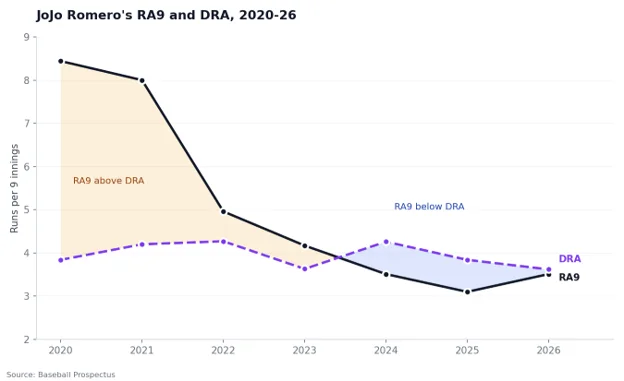
Romero’s early results were also shaped by circumstances. In his first two seasons, his RA9 ran well above his DRA. A ground-ball pitcher can suffer when the defense behind him turns contact into outs less often: third baseman Alec Bohm posted a -1.8 DRP from 2020 through 2021. Philadelphia’s home park was another factor. Citizens Bank Park had a 102 park factor, fifth-highest in the majors, while Busch Stadium’s 97 ranked 26th.
Small samples added noise. Romero threw just 21⅔ innings for the Phillies from 2020 through 2022, enough for a couple of poor outings to sharply inflate his RA9. He has since posted a lower RA9 than DRA in both 2024 and 2025: 3.51 against 4.26, then 3.10 against 3.84. That pattern helps explain the gap, even if it doesn’t settle whether the results will hold.
A repertoire built around contact
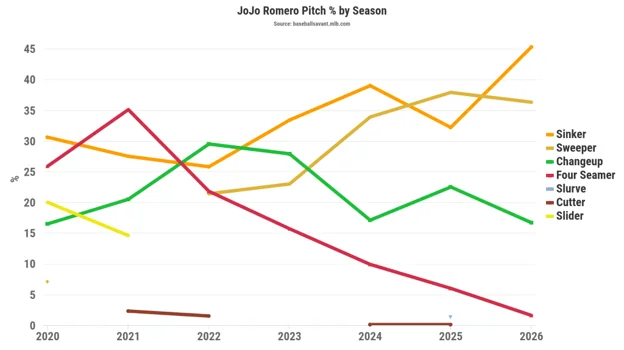
The clearest change has been Romero’s pitch selection. He moved away from a four-seam fastball that never offered standout velocity or movement, adding a sinker and a sweeper instead. The four-seamer accounted for 35.1% of his pitches in 2021, fell to 10% by 2024, and dropped to 2% this year.
Romero introduced the sweeper in 2022 and has used it about 37% of the time since 2024. His sinker reached a career-high share of roughly 45% this year. Together, the two pitches work well against left-handed hitters; against right-handers, he also has a changeup to vary the look.
That mix suits a pitcher whose game depends on weak contact and ground balls. His ground-ball rate reached 55.4% in 2025, after dipping to 46.8% in 2024. The numbers don’t describe a dominant strikeout arm, but they do show a reliever who has found a repeatable way to get outs.
Naming key: orange = sinker, light brown = sweeper, green = changeup, red = four-seam fastball, dark brown = cutter, yellow = slider.
Postseason value in Milwaukee
Milwaukee’s strong defense makes the club a natural fit for a ground-ball pitcher. Romero has delivered in that role this postseason, recording a 42.1% K-BB% across four appearances and 5⅓ innings. In Game 4 of the National League Championship Series, he struck out Max Muncy to end the sixth inning and strand Kyle Tucker at third.
Romero’s career has rarely drawn much attention; middle relievers often work outside the spotlight. Yet he has outperformed his FIP for three straight seasons, with a style that stands apart from the velocity-first mold. Milwaukee’s player-development staff has helped him make the most of that profile. Now, with Romero pitching in the World Series, his unusual path has become part of the Brewers’ postseason story.


