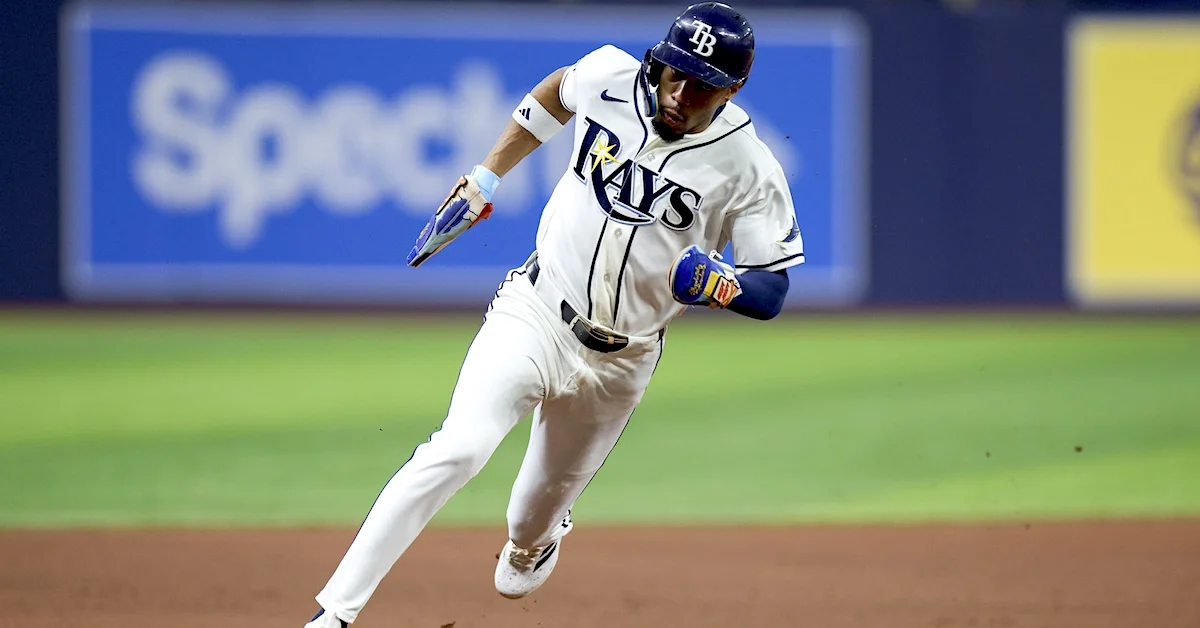
Chandler Simpson came within 10 competitive runs of the single-season record while spending much of his season batting fifth or sixth. That gap says as much about Tampa Bay’s lineup choices as it does about the Rays outfielder’s unusual offensive game. If Simpson earns a regular spot near the top of the order, he could challenge a record that has stood since Amed Rosario set it in 2022.
A statistic built around full speed
Statcast uses “competitive runs” to identify plays that offer a useful reading of a player’s sprint speed. A routine groundout, when a batter runs down the line without going all out, doesn’t qualify. The tracked plays include a batter running to first on a topped or weakly hit ball, or a runner advancing two or more bases, with an exception for scoring from second on an extra-base hit.
It’s a measure designed to help calculate sprint speed, but the totals also tell a story about how a player creates offense. A high count generally means plenty of balls in play, chances to take extra bases and a style that puts pressure on defenders. Strikeouts and walks can limit those opportunities; so can a batting order spot that produces fewer plate appearances.
Rosario’s 2022 season remains the benchmark. He recorded 369 competitive runs in 670 plate appearances, nearly 70 more than any other player that year. He also hit nine triples, led the majors in that category, and posted a 104 wRC+ while playing shortstop for Cleveland. His competitive-run total remains the highest recorded in a single season.
Simpson finished with 359 in the season listed as 2026, placing him fourth on the all-time single-season leaderboard. He did it in 612 plate appearances, fewer than every other player shown among the top 10. His pace makes the ranking more striking: Simpson averaged 0.59 competitive runs per plate appearance, the highest rate among those listed.
Simpson’s approach creates chances to run
Simpson’s swing is tailored to put the ball in play on the ground. He uses little body movement, sacrificing power for a compact, adjustable motion. His slow swing and unusually flat path keep the bat in the hitting zone for a long time, helping him make contact while limiting the likelihood of lifting the ball. The intended result is a low line drive or a hard grounder, rather than a swing geared toward home runs.
That approach pairs with exceptional speed. Simpson has the fastest home-to-first time in baseball and posted the third-highest contact rate. He can turn a ground ball into a close play, then use his legs once he reaches base. This postseason, he has shown that range of pressure: dropping well-placed bunts, stealing bases, chasing down fly balls and making infielders rush their throws.
The connection to competitive runs is direct. Ground balls and frequent contact give Simpson chances to race to first; reaching base gives him opportunities to advance on the next play. His speed shapes not just the outcome of individual at-bats but the kinds of plays that produce the statistic.
The record table shows how unusual his total is in context. Dee Strange-Gordon also recorded 369 competitive runs, in 2017, across 695 plate appearances. Ben Revere came close with 368 in 2015, from 634 plate appearances. Simpson’s 359 in 612 opportunities puts him ahead of several familiar speedsters, including Elvis Andrus, Mookie Betts, José Altuve, Jean Segura, Adam Eaton and DJ LeMahieu.
Batting order has held down the total
Competitive runs accumulate with opportunities, and the players atop the leaderboard generally had more of them. Rosario, Strange-Gordon and Revere spent most of their time in the first or second spot. Simpson’s most common lineup position was fifth; he batted sixth nearly as often as he led off. That placement likely cost him a meaningful number of trips to the plate.
Batting order is not a small detail for a counting statistic. A leadoff hitter gets more chances over a season than a player hitting ninth, and the difference can amount to dozens of plate appearances. Teams have increasingly placed their strongest hitters near the top, especially in the second spot, but Simpson’s role has reflected both his on-field production and the Rays’ other lineup options.
His performance against left-handed pitching has also affected his playing time. Tampa Bay sometimes sits him against lefties, against whom he has a 76 wRC+ over his two major-league seasons. Simpson’s overall wRC+ this season was 93. Rosario’s 104 mark in 2022 helped support an everyday role and a higher lineup spot; Simpson has not yet made that same case as consistently at the plate.
There’s a plausible path to a much larger total if he improves enough to play every day and hit leadoff. On an offense as strong as Tampa Bay’s, that role could bring more than 700 plate appearances. At his current rate of competitive runs, that volume would put the existing record under serious pressure. That projection depends on the rate holding and on the Rays giving him those opportunities, so it’s a possibility rather than a forecast.
The next step is earning a regular leadoff role
Simpson is still in his second major-league season and is 25, leaving room for his hitting to develop. His speed already adds value to his offensive profile, so he may not need a dramatic change at the plate to become a stronger everyday option. A modest improvement could help him stay in the lineup against left-handed pitching and move closer to the top of the order.
He also arrived in the majors with an unusual batting-title pursuit. Baseball America’s JJ Cooper noted that Simpson was aiming to become the first player to win a batting title in college, the minors and the majors. That effort reflects how much of his game depends on putting balls in play, though his major-league production still has to support a regular role.
For now, the clearest takeaway is the mismatch between Simpson’s opportunities and his output. He reached the fourth-highest competitive-run total on record while hitting mostly in the middle of the lineup. If his bat earns him a full season near the top, the record Rosario set may become a realistic target rather than a distant mark.
| Year | Player | Competitive Runs | PA | AVG Batting Position |
|---|---|---|---|---|
| 2022 | Amed Rosario | 369 | 670 | 2.5 |
| 2017 | Dee Strange-Gordon | 369 | 695 | 1.3 |
| 2015 | Ben Revere | 368 | 634 | 2.3 |
| 2026 | Chandler Simpson | 359 | 612 | 4.2 |
| 2017 | Elvis Andrus | 348 | 689 | 2.8 |
| 2016 | Mookie Betts | 344 | 730 | 1.8 |
| 2017 | Jose Altuve | 343 | 662 | 2.7 |
| 2016 | Jean Segura | 342 | 694 | 1.1 |
| 2016 | Adam Eaton | 342 | 706 | 1.3 |
| 2017 | DJ LeMahieu | 341 | 682 | 2.0 |


