SunSong makes a strong case for a different kind of surf film: one where the pleasure of watching the crew matters as much as the waves they catch. Produced by Mikey February for Spearhead Unlimited, it centers on 17-year-old Fijian surfer James Kusitino at Cloudbreak, then gives a deep lineup of surfers room to leave their mark. The result isn’t built around one rising talent alone; it uses his energy as a way into a broader portrait of a group surfing together. That distinction gives the film more to offer than a succession of impressive rides.
The film, directed and edited by Sam Smith, features Tosh Tudor, surfer and shaper Kobe Hughes, Frankie Harrer, and Indigenous Australian surfer Lungi Slabb. Wade Carroll, Dave Fox, and Ian Thurtell filmed it, sharing the work of capturing both the breaks and the people moving through them. After premiering across the US, SunSong is now available to watch. Here’s the thing: the film’s appeal isn’t only its access to Cloudbreak, but the way it gives its surfers room to feel like a crew rather than a list of names.
Cloudbreak through Kusitino’s eyes
Kusitino’s rapid rise over the past year gave the film its starting point. At Cloudbreak, he meets serious surf with a playful approach: the bigger the wave, the broader his smile. His talent is plain to see, but his delight in the session gives his surfing its pull. You can feel that energy whether you’re watching from the channel or a screen. That combination matters in a film like this, where technical ability can easily become the whole story. Kusitino’s reactions keep the focus on what the surfing feels like, not just what it looks like.
His profile has also brought new attention to Fijian surfing. Kusitino once bused tables to earn gas money for trips to Cloudbreak; now he’s traveling the world as one of the sport’s young standouts. That change gives his appearance here a personal arc without asking the film to turn into a conventional biography. He’s not the only Fijian pushing for a place on the international stage, and the film leaves room for others to follow. This is more significant than it looks: a young surfer’s visibility can make a local scene harder for audiences to overlook, even when the film isn’t trying to make a formal argument about representation.
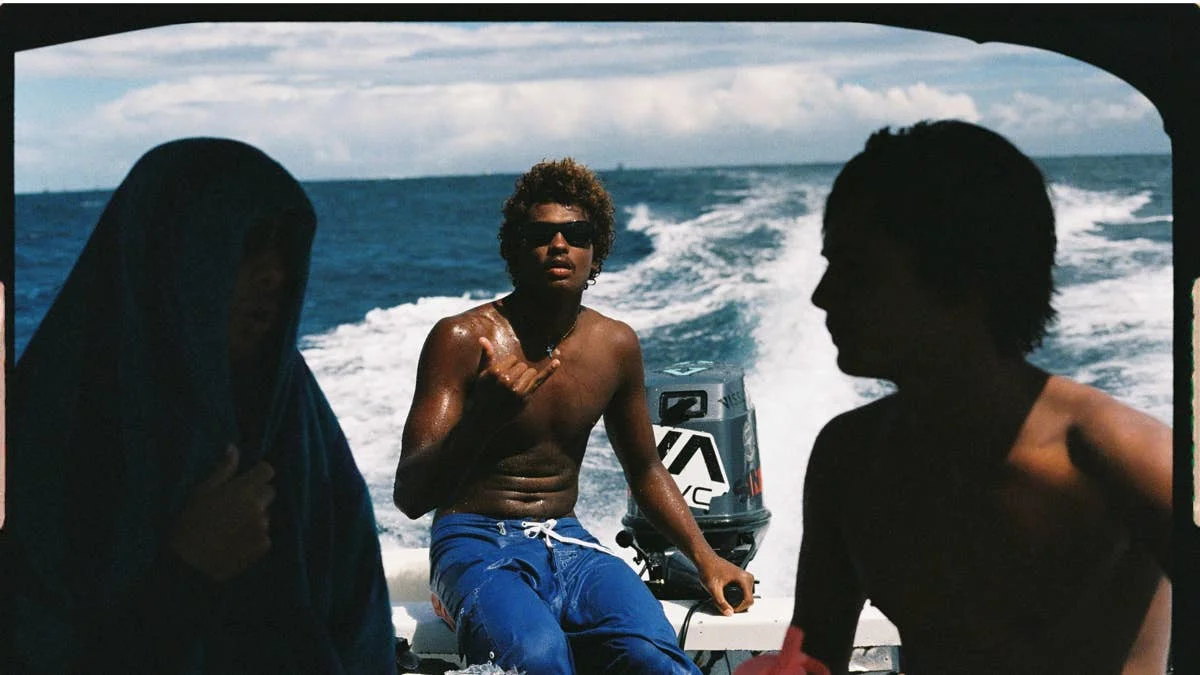
Wade Carroll
Cloudbreak gives the whole crew a demanding backdrop, but Kusitino isn’t the only one who shines. Much of the group’s quiver was lost in transit and arrived days late. The boards that made it became a shared resource, with surfers trading equipment and finding different lines on the same waves. Rather than dwell on the missing gear, the film makes that practical limitation part of its loose, exploratory character. Similar constraints often change how a group approaches a session: familiar habits fall away, and riders have to adapt to what’s available. The result here feels less like a planned showcase and more like a crew figuring things out together.
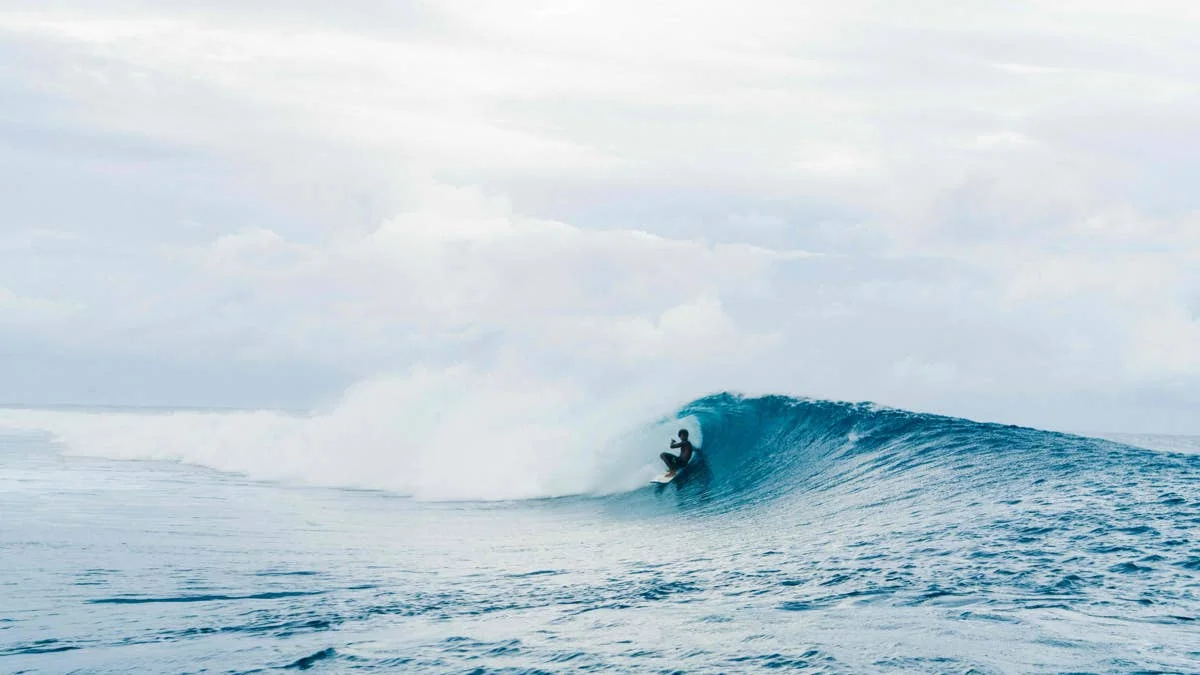
Sam Smith
A soundtrack with its own current
The music gives SunSong another layer. Hugh Masekela and Letta Mbulu, both South African artists, sit alongside American saxophonist Azar Lawrence and field recordings gathered during the trip. Those sounds draw a connection between Fiji and Africa through shared rhythms, giving the film a musical identity beyond a standard surf soundtrack. The choice also changes the way the footage lands: music isn’t simply there to push the action along, but helps establish a mood that can sit beside the movement. It’s a considered pairing, and one that makes the film feel less interchangeable with other surf edits.
February’s taste runs through the whole production: the choice of surfers, the musical pairings, and the emphasis on style and pleasure. His films reward repeat viewing, and this one has sequences that make you want to rewind. Kusitino fades, drives back toward the foam, then slips beneath the lip; later, he lays back into a heavy Cloudbreak pit with striking control. Those moments give the film its sharper edge, but they work because the surrounding pace doesn’t treat every wave as a climax. A pause, a change of line, or a rider’s expression can matter just as much as the biggest maneuver. And yet, the film never loses sight of the waves themselves.
Why the film’s looseness matters
What sets SunSong apart is its sense of fun. The surfing feels spontaneous, the crew’s shared boards keep the sessions loose, and the film lets each ride breathe. That approach is a useful counterweight to surf videos that rely on constant escalation, where each sequence has to outdo the last. Here, the pleasure comes partly from watching different surfers respond to the same place in their own ways. (And this is the part most people overlook.) The film’s relaxed tone isn’t a lack of craft; it depends on choices about pacing, music, and whose surfing gets room to register.
If you’re working in this space, SunSong is a reminder that a strong surf film doesn’t need to make its central surfer carry every scene. Kusitino gives the story a clear center, while the ensemble and soundtrack broaden its reach. The balance isn’t perfect proof that every viewer will want to rewind, but it gives the film a personality beyond its location and roster. What this means for you as a viewer is simple: there’s more to watch than the headline rides. A shared session, shaped by limited boards and individual styles. That’s the film’s quiet strength.
It’s an invitation to press play, turn up the soundtrack, and see which moments send you back for another look. SunSong doesn’t need to oversell its premise; its best argument is the time it gives its surfers and the pleasure it takes in watching them surf. The waves are the draw, but the crew is what makes the film stick.
Related: Style is Everything in Craig Anderson and James Kusitino’s Latest Drop


