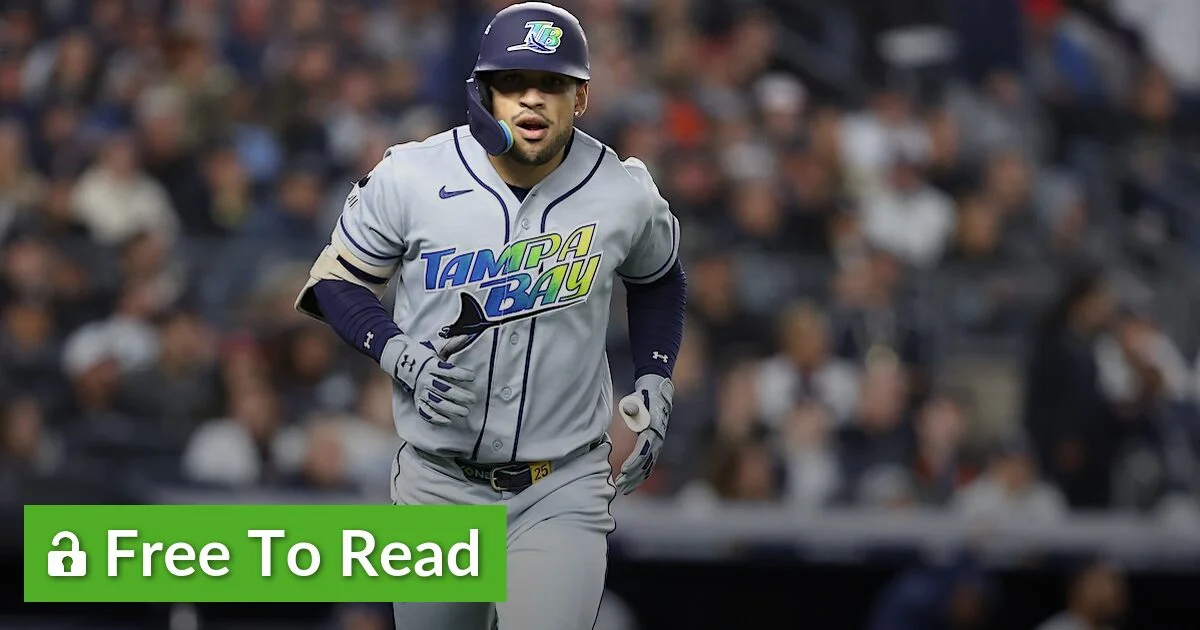
Victor Mesa Jr.’s rise from the fringes of the prospect lists to the middle of a Rays postseason celebration is a reminder that player development doesn’t always follow a scouting report. A year ago — even eight months ago — it was hard to picture him as a playoff hero. Then he hit a decisive home run against the Yankees and helped Tampa Bay finish a sweep. You can follow his numbers on FanGraphs.
Mesa, the son of a celebrated Cuban outfielder and manager, debuted in the majors with Miami in 2025. His prospect stock had already slipped: scouts worried about a long swing and an aggressive approach. The Marlins designated him for assignment in February, before camp opened, to clear a roster spot for a reliever claimed off waivers. Tampa Bay traded for him, and he started 2026 in Triple-A.
By June, the left-handed hitter, then 24 and now 25, had earned a platoon job. Speed and defense got him onto the roster; production against lefties and more power than anyone had projected helped him stay there. In Game 3 of the Division Series, Mesa launched a two-run homer off Max Fried’s final pitch, putting the Rays ahead 4–2. The night got stranger in the sixth, when Mesa tried to catch Anthony Volpe’s home run that wasn’t. Fan interference turned it into a run-scoring double. Tampa Bay held on anyway, swept the Yankees, and moved on to face Cleveland in the ALCS.
“At the beginning of the year, I started being designated for assignment and look at me now,” Mesa said after the Wild Card Series win, beaming under a coating of champagne.
Rays manager Kevin Cash said Mesa’s value went beyond the box score: “Victor Mesa Jr. is a very talented player both sides of the ball. And when we got him up here and he found comfort in playing in that role that he was in basically every day, he really lengthened out our lineup.” Rays president of baseball operations Eric Neander put it more simply in comments to MLB.com: “I don’t know where we’d be without him.”
Mesa had imagined becoming a major leaguer after he and his older brother, Victor Victor Mesa, left Cuba in 2018. He hadn’t imagined getting there with the Rays. “You never know what to expect because I never thought that I [was] going to play for the Rays,” he said after the clincher. “But everything happens for a reason. When we defected, we knew that we wanted to live moments like this. I want to thank [my brother] because he’s a big part of why I’m here.”
A family name, and a long road through the minors
The Mesa name carried weight in Cuban baseball long before Victor Jr. reached the majors. His father, Victor Mesa Sr. (born in 1960), spent 19 seasons as a star center fielder for Villa Clara in Cuba’s Serie Nacional, from 1978 through 1996. He won six stolen-base titles and hit .317/.383/.502, with 273 home runs and 589 steals across the league, postseason play, and Serie Selectiva summer tournaments.
Known as “El Loco,” Mesa Sr. played with a showman’s flair: he heckled pitchers, celebrated openly, and pranced around the bases. United Press International’s Richard Luna captured the reputation in 1987, writing, “As they once said about Reggie Jackson, there is not enough mustard on earth to cover this guy.”
He also became a fixture on Cuba’s national teams, appearing in 20 international tournaments. The standout came at the 1992 Summer Olympics, where he hit .556/.636/1.000 with two homers in five games and won gold. After retiring as a player, he managed in Cuba and Mexico, including Cuba’s 2013 World Baseball Classic team. That roster featured future big leaguers José Abreu, Yuli Gurriel, and Raisel Iglesias.
Victor Victor, born in 1996, played center field for six seasons in Cuba’s CNS: five with Matanzas, one with Industriales. He debuted at 16 in 2012 and represented Cuba in the 2017 WBC. Victor Jr., born in 2001, played outfield for Cuba’s 18U team. The brothers defected in May 2018. Four months later, after being declared free agents, they signed with the Marlins.
The older brother received a $5.25 million bonus and immediately became Miami’s top prospect according to MLB Pipeline. FanGraphs’ Eric Longenhagen and Kiley McDaniel, now at ESPN, were more cautious, rating him a 45+ FV prospect. Scouts liked the brothers’ speed, arms, and defensive instincts.
Victor Victor reached Triple-A but couldn’t turn his showcase tools into sustained minor league success. His career ended in 2023 after he walked out on his team following disagreements with coaches.
His younger brother’s numbers were better, but injuries and a lack of any one standout tool kept him from becoming a top prospect. He appeared in the “Other Bats of Note” section of FanGraphs’ Marlins prospect lists. In the 2025 edition, Longenhagen wrote: “Mesa is a solid average center field defender and therefore a viable depth option, but nothing about his offense is average.” Baseball America and MLB Pipeline placed him 26th and 27th, respectively, among Miami’s top 30 prospects; both assigned him a 40-FV grade.
Longenhagen’s assessment appeared after Mesa had already made a brief major league debut. On May 26, 2025, he struck out against San Diego’s Jason Adam. He played three more games before returning to Triple-A Jacksonville, then came back to the majors on August 31. Across 38 plate appearances, he hit .188/.297/.344. His high point was a September 8 homer off Washington’s Shinnosuke Ogasawara.
Mesa put up a .301/.368/.510 line in 171 plate appearances at Jacksonville, but still missed both Baseball America’s and MLB Pipeline’s 2026 Marlins prospect lists. Miami’s roster decision was blunt: on February 3, it designated him for assignment after claiming 28-year-old reliever Garrett Acton off waivers.
Tampa Bay had reasons to look beyond the scouting grades. The organization had watched Mesa play alongside its prospects in the 2022 Arizona Fall League and come away impressed by his feel for the game. “We realized this was a player who had a lot of intangibles,” vice president and assistant general manager Kevin Ibach told The Athletic’s Will Sammon. “That didn’t really shine in a showcase or a scouting report. But it became, ‘Hey, this guy is probably going to play above his tools to some degree because his baseball IQ is off the charts.’”
Mesa’s breakout fits a broader pattern in Tampa Bay. RosterResource lists 17 players on the Rays’ current 26-man roster and 26 on their 40-man roster as trade acquisitions, more than any other major league team in both cases. Players such as Junior Caminero, Jonny DeLuca, Yandy Díaz, and Drew Rasmussen had been valued by their former clubs, but their eventual impact in Tampa Bay wasn’t a sure thing.
From Durham depth to a middle-of-the-order spark
Acton didn’t make it to the end of March with Miami before being designated for assignment again. Mesa, meanwhile, opened the season at Triple-A Durham. He homered on Opening Day, then missed nearly four weeks after straining a hamstring in mid-April.
He returned to the majors in late May after DeLuca strained his right hamstring. The Rays had also lost Jake Fraley to surgery for a sports hernia. Mesa’s Tampa Bay debut came May 25, one day short of the anniversary of his first major league game. Starting in right field against Baltimore, he hit a two-run homer in the 11th inning off Tyler Wells, who would be traded to Tampa Bay on August 3.
June was mostly a slog, but Mesa began getting most of the starts in right field against right-handed pitching. Before September, his only start against a lefty came July 18 against Boston. He answered with a home run off southpaw Patrick Sandoval.
Through August, Mesa’s .214/.288/.447 line and 102 wRC+ were solid but hardly spectacular. Then he returned from the injured list on September 1 after a left hamstring strain and started against Mets left-hander Sean Manaea. Mesa collected two hits off Manaea and another against lefty reliever Jefry Yan. In September, he started six of Tampa Bay’s 10 games against left-handed pitchers.
That month, Mesa led the Rays with a 184 wRC+, hitting .355/.410/.605 with four home runs in 83 plate appearances. One of those homers came off Sandoval on September 20. Tampa Bay went 16-9 to close the season, clinching the AL East and the league’s top seed.
Across 262 plate appearances, Mesa finished at .260/.327/.498, a 128 wRC+, with 14 homers and nine steals. Against left-handed pitching, he hit .333/.385/.483 with a 146 wRC+ in 66 plate appearances.
Cash credited Mesa’s ability to handle southpaws to the way he uses the whole field. “I think he stays on the ball really well,” the manager said. “We’ve seen him since he’s come up here and the opportunities he’s gotten against left-handed pitching. The ability to shoot the ball the other way on the fastball, pull the breaking ball.”
The results weren’t just a matter of a few well-timed hits. Mesa’s quality of contact was above average, and he beat his expected numbers in part by turning some singles into doubles and doubles into triples. He pulled 19.5% of his airborne balls, a mark in the 60th percentile.
| Season | BBE | EV | LA | Brl% | HH% | AVG | xBA | SLG | xSLG | wOBA | xwOBA |
|---|---|---|---|---|---|---|---|---|---|---|---|
| 2025 | 28 | 91.1 | 14.1 | 7.1% | 42.9% | .188 | .229 | .344 | .418 | .288 | .331 |
| 2026 | 185 | 89.4 | 21.1 | 10.8% | 42.2% | .260 | .249 | .498 | .439 | .355 | .329 |
That’s a striking jump for a player who had been labeled a marginal prospect. Longenhagen says Mesa improved his swing without giving back the contact he had spent years struggling to maintain. “He was a chase-prone guy with a 70-72% contact rate for most of his prospect lifetime (which is in the 30-40 grade range) and below-average power,” he wrote in notes. “Now he’s got roughly average power and is maintaining a viable contact rate, and he didn’t really trade off any contact to add the power.”
Mesa still chased 33.9% of pitches outside the strike zone in 2026. But his 77.9% contact rate was a little above league average, and Statcast’s bat-tracking data shows his bat speed increased from 2025 to 2026. He also narrowed the distance between his feet and opened his stance:
| Season | Avg Bat Spd | Fast Sw% | Attack Angle | Depth in Box | Dist From Plate | Dist Btwn Feet | Stance |
|---|---|---|---|---|---|---|---|
| 2025 | 72.6 | 17.9% | 7° | 26.4 | 29.1 | 31.2 | 5° OPEN |
| 2026 | 74.0 | 38.8% | 10° | 28.6 | 27.6 | 22.9 | 22° OPEN |
On video, Mesa looks less upright and more crouched, with a more pronounced leg kick. Longenhagen sees better timing in the change: “The timing of his leg kick with his hands loading seems cleaner to me now, just watching the tape.” These clips show two swings from 2025: his strikeout against Adam and a flyout from September 13.
For comparison, here are two from 2026: the July 18 homer against Sandoval and another home run on September 20. The latter gives a clear look at Mesa’s wider stance and leg kick.
The glove made the breakout bigger
Mesa’s 2.6 WAR over roughly half a season wasn’t built on his bat alone. In 580⅓ outfield innings — 510⅓ in right, 53 in left, and 17 in center — he recorded 13 DRS and 8 FRV. His 12 DRS in right field tied for fourth in the majors; his 8 FRV tied Seiya Suzuki for the major league lead. Statcast put Mesa’s range in the 93rd percentile and his arm strength in the 94th, based on an average of 93.3 mph on competitive throws.
His first step may be the most eye-catching part. Mesa fell one play short of the two-star play count needed to qualify for the relevant leaderboard; those are plays with a catch probability of 90% or lower. Even so, his outfield jumps ranked first in the majors, ahead of even Pete Crow-Armstrong.
| Player | Tm | 2-Star Outs | Opp | % | OAA | Rxn | Burst | Route | Feet vs Avg | Feet Cov |
|---|---|---|---|---|---|---|---|---|---|---|
| Victor Mesa Jr. | TBR | 22 | 32 | 68.8 | 8 | 5.3 | 2.1 | -2.1 | 5.2 | 39.2 |
| Pete Crow-Armstrong | CHC | 65 | 79 | 82.3 | 23 | 1.8 | 2.6 | 0.0 | 4.5 | 39.1 |
| Ceddanne Rafaela | BOS | 47 | 74 | 63.5 | 16 | 2.0 | 1.9 | -0.4 | 3.5 | 37.8 |
| Wyatt Langford | TEX | 24 | 55 | 43.6 | 3 | 1.2 | 2.0 | 0.1 | 3.3 | 37.5 |
| Jorge Barrosa | HOU | 17 | 26 | 65.4 | 5 | 2.0 | 1.6 | -0.5 | 3.0 | 36.7 |
Mesa’s reads give Tampa Bay an edge
Reaction measures how much ground an outfielder gains over the average player in the first 1.5 seconds after contact; Burst covers the next 1.5 seconds. Victor Mesa led all outfielders in Reaction and ranked second to PCA in Burst. His routes gave some of that advantage back, but he still got the best jumps in the group. MLB.com’s Mike Petriello deserves credit for surfacing the detail.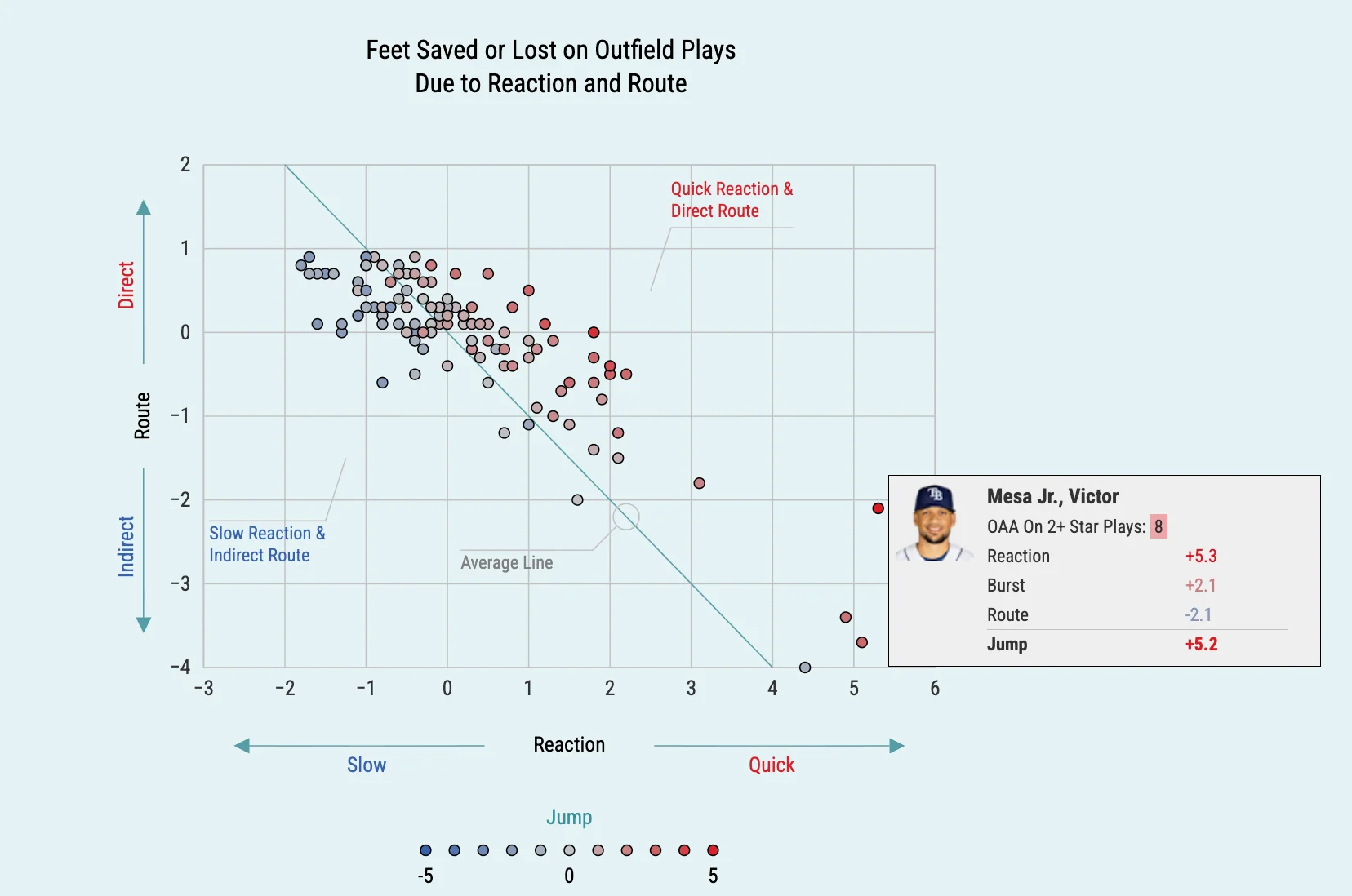 That quick first step matters in Tampa Bay. The Rays’ outfielders combined for 29 runs above average by both DRS and FRV: fourth in MLB by DRS and second by FRV. Chandler Simpson, the left fielder, contributed 8 DRS and 3 FRV; center fielder [Cedric Mullins](https://www.fangraphs.com/players/cedric-mullins/17929/stats/batting) posted 6 DRS and 10 FRV; and DeLuca added 5 DRS and 10 FRV across 787 innings at all three positions. That defense paired neatly with a staff that allowed fly balls at a 40.8% rate, fifth-highest in the majors.
Mesa’s timing showed up in the ALDS, too. He started the first two games in right field, going 1-for-6 with two strikeouts, a single off [Gerrit Cole](https://www.fangraphs.com/players/gerrit-cole/13125/stats/pitching), and a walk against [Ryan Weathers](https://www.fangraphs.com/players/ryan-weathers/23796/stats/pitching), which he followed with a stolen base.
For Game 3, Cash benched left-handed hitter Simpson, moved Mesa to left, and put [Ryan Vilade](https://www.fangraphs.com/players/ryan-vilade/22165/stats/batting) in right. Vilade’s fourth-inning homer off Fried gave Tampa Bay a short-lived 2-1 lead; the Yankees tied it in the bottom half. In the sixth, Fried quickly recorded two outs before [Junior Caminero](https://www.fangraphs.com/players/junior-caminero/28163/stats/batting)’s [105-mph grounder back through the middle](https://www.mlb.com/video/junior-caminero-singles-on-a-ground-ball-to-center-fielder-trent-grisham?partnerId=web_video-playback-page_video-share) narrowly missed the pitcher. Fried’s next pitch was a hanging sweeper. Mesa sent it 401 feet to right-center, paused to admire the shot, then looked toward Tampa Bay’s dugout as Cash urged him to keep running.
“That is the best feeling in baseball, besides winning,” Mesa said. “When you don’t even feel the bat, that means that you got good contact.”


