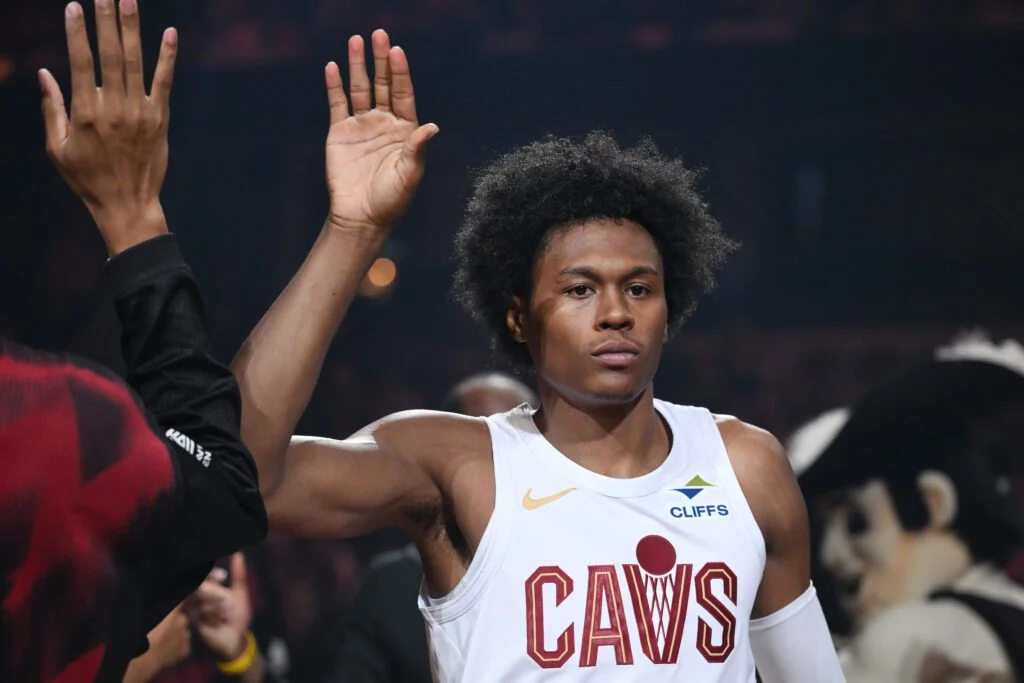
Cleveland’s defensive question
Cleveland’s defensive ceiling may hinge on what Peyton Watson can add around its established frontcourt anchors. The Cavaliers finished 15th in defensive rating last season at 114.1, a middle-of-the-pack result despite having former Defensive Player of the Year Evan Mobley and rim protector Jarrett Allen. Their presence gives Cleveland a foundation near the basket, but it doesn't answer every defensive problem. A team still needs perimeter defenders who can stay in front of opponents, disrupt actions and keep difficult assignments from turning into easy looks.
Watson sees himself as one answer to that need. After Cleveland’s 119-105 win over the Orlando Magic, which brought the team to 1-1, he described defense as his clearest route to making a difference. “I think that I’m somebody who can be super elite on that end and change the outcomes of my games with defense,” he said after the game.
That confidence is striking, but the claim comes with a practical test: can he make a defense better across a full role, rather than in isolated moments? Watson said he enjoys taking on different challenges and wants to fit his approach into Cleveland’s scheme and principles. That suggests a player who understands the job includes learning when to pressure, when to hold position and how to work with the defenders behind him. He’s framing his value around possessions that end before they become scoring chances.
A perimeter role with early signs
Watson’s box score against Orlando was modest: six points, four rebounds and two steals. The numbers offer a narrow snapshot, though, and his energy and defensive activity stood out more than his scoring. For a team seeking a perimeter defender, that kind of activity can matter even when it doesn't produce a large point total. It’s an early indication of the role he wants, not proof that he’s already secured it.
That assignment could matter more than his raw production. With James Harden and Donovan Mitchell leading the offense, Watson may have fewer chances to score than he did during his breakout campaign. Cleveland doesn't need every player to create offense at the same rate; it needs role players to make their minutes fit around the primary options. Watson’s value will depend on whether he can connect lineups, pressure opponents and contribute without needing the ball.
Here’s the thing: a defensive role isn't passive just because it doesn't begin with a shot. Watson may need to switch assignments, communicate through screens and make quick decisions when the offense tries to pull Cleveland’s bigger defenders away from the rim. Those demands can be difficult to measure in a single box score. If you're working in this space, you’ll recognize the broader roster question: can a team’s supporting pieces cover the kinds of matchups its stars would rather avoid?
Mitchell sees more than athleticism
Mitchell’s endorsement focused on qualities that don't show up neatly in a scoring line. He called Watson “a winner” and pointed to his defensive competition, basketball IQ and communication in film sessions and huddles. Those details describe habits teammates can see away from the final score: how a player talks through a coverage, responds to coaching and helps others stay organized. Mitchell also said Watson had shown what he could do when Nikola Jokić was out last season, giving Cleveland a dimension it didn’t already have.
That assessment carries weight because it describes a teammate who may help organize a defense as well as make plays within it. Athleticism can help a defender recover or contest a shot, but positioning and communication often determine whether the rest of the lineup can respond together. Mitchell’s comments suggest he sees Watson as more than a collection of physical tools. And yet, praise from a teammate is a starting point for evaluation, not a substitute for sustained results on the court.
Watson’s arrival followed a prolonged contract negotiation with his former team, the Denver Nuggets, before he was traded to Cleveland and joined a roster featuring Harden, Mitchell and Mobley. That change gives his role a different context: he’s arriving on a team with established offensive leaders and a frontcourt that already shapes its defense. For Watson, fitting in may mean finding ways to affect games without asking the offense to run through him.
What the early numbers can—and can’t—show
Watson averaged 14.6 points, 4.9 rebounds, 0.9 steals and 1.1 blocks per game last season. His preseason averages were lower—6.5 points, 4.0 rebounds, 2.5 assists, 1.0 steals and 1.0 blocks—but those early numbers offer limited evidence about how his production will settle into Cleveland’s rotation. Preseason output can reflect different minutes and roles, so a direct comparison doesn't establish what he’ll contribute once the regular season takes shape. The more useful question is whether his defense earns him a dependable place in the rotation.
The Cavaliers retained the core that reached the Eastern Conference finals and added a forward who believes defense can change games. Watson has a clear opportunity to address a need, but the fit will be judged by more than his stated ambition or one performance against Orlando. Cleveland will need to see consistent effort, sound decisions and communication across matchups. The numbers here are underwhelming as an argument on their own; the role is more compelling than the sample.
The test for Cleveland
This is more significant than it looks. A perimeter defender who can support Mobley and Allen may help Cleveland protect the paint without asking its bigs to solve every problem themselves. That impact can show up in how comfortably the team handles opposing actions, not just in steals or blocks. It also depends on Watson being useful when he isn't making a visible defensive play—staying positioned, following the coverage and helping a teammate recover.
What this means for you as a reader tracking Cleveland is that Watson’s early scoring line probably won’t tell the whole story. Watch how the team uses him against different assignments, whether his communication matches Mitchell’s description and whether he can stay effective alongside the Cavaliers’ main offensive options. If those pieces come together, he could give Cleveland a kind of perimeter support its established frontcourt doesn't provide by itself. If they don’t, his defensive confidence will remain a promise waiting for evidence.
For now, the case is plausible, but it’s still a case. Cleveland has a defender who wants the hard assignments and a roster that could use more help on the perimeter. The season will show whether those two facts add up to a meaningful lift for a unit that has room to climb.


