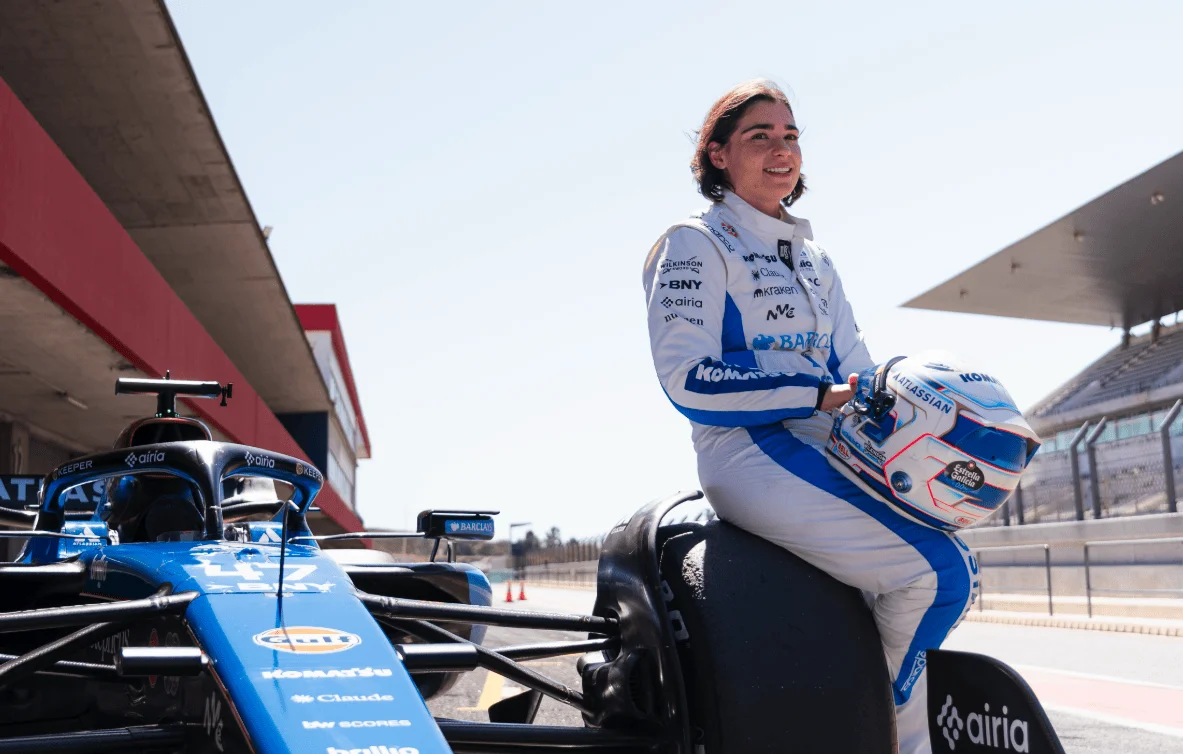
Jamie Chadwick’s 32 laps in a Williams Formula 1 car were a personal milestone, but her read on the test reaches beyond one day at the wheel. The session strengthened her belief that a woman can eventually reach the F1 grid, while underscoring where the sport needs to produce more results: the transition from karting into cars and through Formula 3 and Formula 2.
Chadwick drove Williams’ FW47 at Portugal’s Autódromo Internacional do Algarve in late September as part of the team’s Testing of Previous Cars program. The car was Williams’ 2025 challenger, which recorded three podiums and helped the team finish fifth in the Constructors’ Championship, its best result since 2017. Chadwick became the second woman to test a Williams F1 car, following Susie Wolff, who drove in practice sessions at the 2015 Spanish and British Grands Prix.
For Chadwick, now a Williams team ambassador and an adviser to F1 Academy, the test connected a long relationship with the team to a rare chance to experience modern F1 machinery. She said she had not expected the opportunity to come around after moving on from her earlier role in Williams’ young driver program. The car’s performance, meanwhile, gave her a fresh perspective on what it takes to drive at the top level.
What stood out in the FW47
Chadwick called the drive “pretty phenomenal” and said it exceeded her expectations. Her career has put her in a wide range of racing cars, but she described the FW47 as a different proposition, with performance and precision that she had not encountered before.
Braking was the clearest point of difference. Chadwick said the car responded so sharply that “you just breathe on the brake pedal and then it comes to an instant stop.” She also noticed how accurately it followed her inputs. The car repeatedly carried her to the apexes she was aiming for, she said, while making clear that driving it effectively and finding its limit are separate challenges.
Portimão made the contrast between corner types especially apparent. In slower sections, Chadwick still felt the car’s weight. Through medium and fast corners, the downforce and performance became far more striking. She thought further running would have helped her find more speed, but even 32 laps showed what the FW47 could do.
Her description gets at a distinction that can be lost when a test is reduced to lap count or a headline. Chadwick had enough experience to recognize the precision of the car, but she did not suggest that one session made her an expert in its limits. The test offered a direct encounter with F1 performance and a sense of how much there was still to learn.
A team relationship that came full circle
Chadwick joined Williams in 2019, when Claire Williams was leading the team, and continued as a young driver while competing in W Series. In recent years, she moved into an advisory position with F1 Academy. She said that even after leaving the young driver role, she still felt connected to Williams, though she had stopped expecting to drive one of its F1 cars.
She credited Williams with a record of supporting women in motorsport and said the team had given her an opportunity few other teams have offered. Her test made her only the second woman to drive a Williams F1 car. The number is small, she acknowledged, but she pointed to it as evidence of the team’s support over time.
Advice from people around the team helped her approach the session. Wolff, now F1 Academy’s managing director, had been a trusted sounding board for Chadwick over the years. Before the test, Wolff’s guidance was to enjoy the experience, avoid a crash and make the most of the chance. Chadwick saw the comparison with Wolff’s own Williams outings, including her Formula 1 practice appearances, while recognizing that the pressure on Wolff had been greater.
Williams drivers Alexander Albon and Carlos Sainz also offered encouragement. Chadwick said she speaks with Albon regularly and values his advice. She encountered Sainz the day before travelling to Portimão; his suggestion was to settle into a pace she was comfortable with, enjoy the car and make the most of an unusual opportunity.
Why representation matters
Wolff’s example mattered to Chadwick well before this test. Early in her career, she said, it could be difficult to picture herself in an environment where she did not see anyone like her. Watching Wolff get into an F1 car helped make that path feel possible. Chadwick now hopes her own Williams test can offer a similar point of reference to younger drivers.
That motivation sits alongside the personal achievement. Chadwick said she was grateful for the day and excited by the female talent coming through the sport, which she considers stronger than she was at the same age. Her role advising F1 Academy gives her a closer view of that next generation, and she sees the test as one way to keep attention on what young drivers might achieve.
Her own record helps explain why the test drew attention. Chadwick won the British GT Championship in 2015, becoming the first woman to take the title. In 2018, she became the first woman to win a British F3 race, at Brands Hatch. She claimed the inaugural W Series title in 2019, defended it in 2021 and won a third championship in 2022. Her racing has also included Extreme E, Indy NXT and endurance competition.
In Indy NXT, Chadwick scored 262 points across 14 races in 2023. Over two seasons in the series, she became its first female winner on a road course with a victory at Road America and also earned a podium in Indianapolis. She finished seventh in the 2024 standings with Andretti Global, scoring 310 points. Her subsequent endurance racing included European Le Mans Series campaigns with IDEC Sport in 2025 and 2026, and a reserve role with Genesis Magma Racing’s Hypercar program in the World Endurance Championship.
The path to an F1 seat
Chadwick believes a woman will eventually race in Formula 1. The FW47 test, she said, affirmed that the prospect is possible. But her optimism comes with a clear view of the barriers: reaching F1 is exceptionally difficult even for drivers who have won at the junior levels. She pointed to current Formula 2 and Formula 3 champions who do not have Formula 1 seats as a reminder of how narrow the opening is.
For women to reach that level, Chadwick argued, the work has to begin earlier. The critical progression runs from karting into car racing, then through Formula 4 and into Formula 3 and Formula 2. Building talent through those stages and enabling drivers to achieve success there would make an eventual F1 contender more plausible.
That’s the larger significance of a 32-lap test. A woman driving an F1 car is visible and memorable; sustained progress through the junior ranks is what could turn that visibility into a place on the grid. Chadwick’s experience has given her a sharper sense of the machinery and renewed confidence in the destination. The next measure will be whether more young drivers can make the steps that bring it within reach.
Want to stay updated on all the latest F1 news? Download the brand new SB Nation app and join our F1 Community! There, you can read all the latest from the paddock and talk about Formula 1 all year long with fans from around the world!


