The fall looks offered a useful mix of signals: a Royals teenager whose bat held up against quality pitching, several Giants arms with standout secondary pitches, and Padres fliers built around specific traits. These were short viewings, so the clearest conclusions are about what each player showed in the moment—and what still needs to develop.
The notes below draw on appearances at instructional league and, for some Royals players, the Arizona Fall League. That context matters. A sharp inning or a difficult at-bat can reveal a pitch or skill, but it can’t settle questions about durability, role or long-term projection.
Kansas City Royals
Angeibel Gomez, OF
At 17, Gomez is already on the Top 100, and the fall offered a strong case for the part of his profile that matters most: he can hit. At 6-foot-2, he has a tapered build and moves well in the batter’s box. He isn’t an extreme athlete in the mold of Elly De La Cruz, but his bat is quick, and his decisions and adjustments stood out against some of the best pitching he’s faced.
Gomez handled several difficult tests. He fought off above-average velocity inside, turned around a 97 mph fastball above the belt, and drove a hard pitch up in the zone on a line. He also stayed competitive against breaking balls, fouling off a couple of tough sliders and taking another just below the zone. He did chase at times, including a curveball in the dirt, so the plate discipline isn’t finished. Still, the quality of the contact and his ability to adjust make this an encouraging look.
The open question is how much more his body and power will develop. Gomez already shows average raw power, with room to add strength, but the projection here leans toward comfortably plus power rather than an 80-grade outcome. He doesn’t look like an early-maturing player, yet he also doesn’t project as an obvious late physical breakout like Sebastian Walcott did at the same age.
His defensive home is likely a corner outfield spot. He didn’t show much speed in the field or on the bases, though age leaves room for change. If he settles in right field as a right-handed hitter, the bat will carry much of the profile. My read from a short look: Gomez appears to be a very good prospect with a particularly compelling hit tool, while a generational ceiling remains harder to support.
Justin Lamkin, LHP
Lamkin’s best argument for a starting role is his feel for pitching. I watched him in instructional league and again about a week later in the AFL. He repeats a balanced delivery, strides well and finishes cleanly. There’s also a small timing wrinkle: his lead leg appears to hang in the air for an extra beat, which can make the low-90s fastball tougher to track than its velocity and movement suggest.
His slider and changeup give him a more interesting foundation. Both flashed above-average quality, and the slider played as a plus pitch against AFL hitters. Lamkin can locate the slider and fading change consistently, with aggressive left-handed hitters particularly vulnerable to the breaking ball. The slider is tight more than sharp, however. When it stays up, it can be hit hard; Washington’s Jorgelys Mota punished one that missed its intended path toward the back foot.
Starting pitching is a demanding fit for a pitcher without a major fastball or truly exceptional secondary arsenal. Lamkin’s command, delivery and ability to use his pitches give him a plausible route, but continued refinement—especially in the slider—will shape how far that route goes.
Hiro Wyatt, RHP
Wyatt looked more physical than in previous viewings, a welcome change for a pitcher previously described as slightly undersized. He also appears to be testing a slower version of an already understated delivery. One scout’s response when the change came up captured how much it can vary: “It’s different than what I saw last week.”
His stuff looked normal across two outings after a core injury cost him most of 2026. Wyatt sat 93–95 mph with sink and showed a plus sweeping breaking ball that missed bats. He also has a tighter slider, used less often, and a changeup that tended to arrive without much action. His finish pulls him toward first base, and the ball often follows that direction, leaving him mostly working to the glove side.
Injuries have limited Wyatt’s chances to build command across the plate, extend his outings and develop a reliable option against lefties. His slow, repeatable cadence may also give hitters time to track the delivery. For now, the combination points more readily toward relief or shorter starts than a conventional rotation role.
Taylor Rabe, RHP
Rabe, a late first-round pick in this year’s draft, is difficult to assess from video alone. From behind the plate, his delivery looked especially awkward to follow: a hitch in the stride and a hidden arm action make it hard to pick up the ball cleanly.
He threw downhill at 94–96 mph, although the fastball’s shape varied considerably. Rabe also showed two low-spin breaking balls that flashed above average and a changeup he used sparingly. A couple of pitches slipped away and hit the backstop, but he otherwise worked around the plate and limited contact.
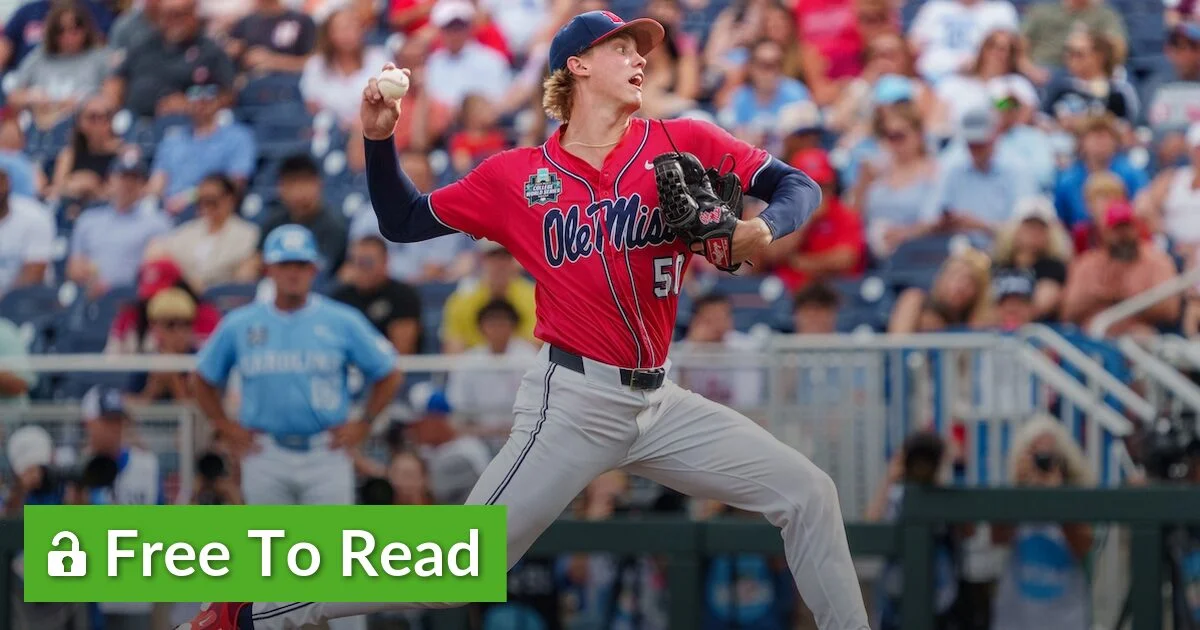
The profile is intriguing because the ingredients don’t fit neatly together: deception, variable fastball movement and unusual spin traits, alongside athleticism and physical projection. Rabe has limited experience against high-level competition—he threw 92.1 innings at Ole Miss—so there’s substantial uncertainty. That makes him an appealing arm with a wide range of possible outcomes.
San Francisco Giants
Carson Bolemon, LHP
Bolemon made a strong impression in a brief outing, showing both physical presence and a delivery that supports his pitches. Listed at 6-foot-4 and 215 pounds, he looks every bit the size, particularly for his age. He controls his body well and uses a loose, hard-to-see arm stroke, helping a low-90s fastball play above its raw velocity.
His command is advanced for a high school pitcher, and his frame and delivery leave room for it to improve further. A low-80s curveball and mid-80s changeup both flashed plus. He mixed in a mid-80s slider once or twice, though the viewing angle didn’t provide a clear read on it. The combination gives the Giants a promising starting point for a mid-rotation prospect, with added velocity a possible boost.
Henry Lalane, LHP
Lalane threw just one inning, but the fastball was the least compelling of three pitches that showed above-average potential. It reached 95–97 mph without especially notable movement. His upper-80s changeup, by contrast, sinks and fades late, and it drew swings and misses, including one from Angels third-round pick Gavin Grahovac.
The mid-80s slider also looked sharp despite an unremarkable raw spin rate. Lalane throws strikes and can locate all three pitches, giving him a chance to start. His stiffness is the main concern. A scout who has followed him for several years said he “looks stiffer” than he did in the Yankees’ FCL. If the looseness doesn’t return, a bullpen role could still make good use of his pitch mix and command.
Beau Bryans, LHP
Bryans was a seventh-round selection, but his fall showings put him on the radar for a more prominent place in the Giants’ next prospect report. He pitches from a low slot with a pronounced crossfire, and showed an unusually good ability to move the ball around the zone for a player of his age.
His fastball sat 94–95 mph with a flat release angle. The slider is the standout: an upper-80s pitch with sweeping action and late depth that already looks plus. It missed plenty of bats across two short outings, and left-handed hitters struggled to make contact. His college walk rates raise questions about whether he’ll hold up as a starter, but the stuff could carry him quickly in relief if he maintains the strike throwing shown on the backfields.
Drake George, RHP
George’s return to the mound was the main story. The unheralded 13th-round pick from Lewis-Clark State looked like a sleeper starter in 2025, then tore his UCL and missed the entire 2026 regular season. This outing was the first look at him since the injury.
His fastball was down from its previous 93–96 mph range, sitting more often at 91–94 and fading as the outing went on. The breaking ball also looked more slurvy than it had the previous summer. George still threw strikes and used all three pitches, including a fading changeup. For a pitcher returning from Tommy John surgery, the useful takeaway is that he’s back on the mound; longer outings next spring should offer a clearer read on his recovery and potential.
Alberto Laroche, RHP
Laroche also returned after missing the 2026 regular season. The right-hander has a loose arm and an easy delivery. He opened both appearances at 92–94 mph, then reached 96 later in each outing as he warmed up. An average slider and changeup rounded out the mix. It was an encouraging return for an arm that had ranked among the DSL’s best in 2025.
Alex Solis, RHP
Solis, San Francisco’s 14th-round selection in July, has a pitch that gives the rest of the profile a reason to matter. His low-80s split-change comes with good arm speed and had hitters out in front throughout a short outing, producing about six swings and misses against ACL Rockies hitters.
The other pieces are more ordinary: fair athleticism and average arm strength. Late in the draft, a pitch with this kind of potential can make a player worth tracking. Solis’ changeup was the clear standout, and the next question is whether the rest of his arsenal can support it.
San Diego Padres
Jhoan De La Cruz, SS
De La Cruz’s glove gives him a clear defensive strength. He covered ground to both sides at shortstop, released the ball quickly and showed enough arm for the position. His slight build remains a limitation, and a poor season at the plate in the ACL means he’ll need to repeat the level. The defense is already worth watching; the next step is a better offensive showing.
Tyler Pitzer, RHP
Pitzer had two years of college eligibility remaining when he signed with San Diego as an undrafted free agent this summer. The early appeal is easy to identify: he sits in the mid-90s with good carry from a high slot, and his sharp, two-plane slider reaches the upper 80s with strong spin.
The delivery needs work. Pitzer has a deep arm stroke and enough motion to make it difficult to repeat, but the fastball and slider give him traits worth developing. His fall showing made the signing look like a worthwhile flier.
Ty Brachbill, RHP
Brachbill, a 14th-round pick from a small Division I program, offers a different kind of upside. He changes timing, throws strikes and varies the shape of his slider. That breaking ball was producing about 2,800 rpm, several hundred rpm higher than it did during the spring in college.
His fastball sits in the low 90s without standout movement, and his arm strength is limited. A professional strength and conditioning program could help him add velocity, but that remains a possibility rather than an established outcome. The Padres have a pitcher who knows how to work, with further development hinging on whether the fastball can become a more effective partner to the slider.
Across the three systems, the most useful fall signals came from specific skills: Gomez’s ability to handle premium stuff, the Giants’ supply of distinctive secondary pitches and the Padres’ collection of developmental bets. The next looks will matter most where the present tools leave the biggest questions—Gomez’s eventual defensive fit, several young arms’ command and durability, and whether San Diego’s fliers can add to what they already do well.


