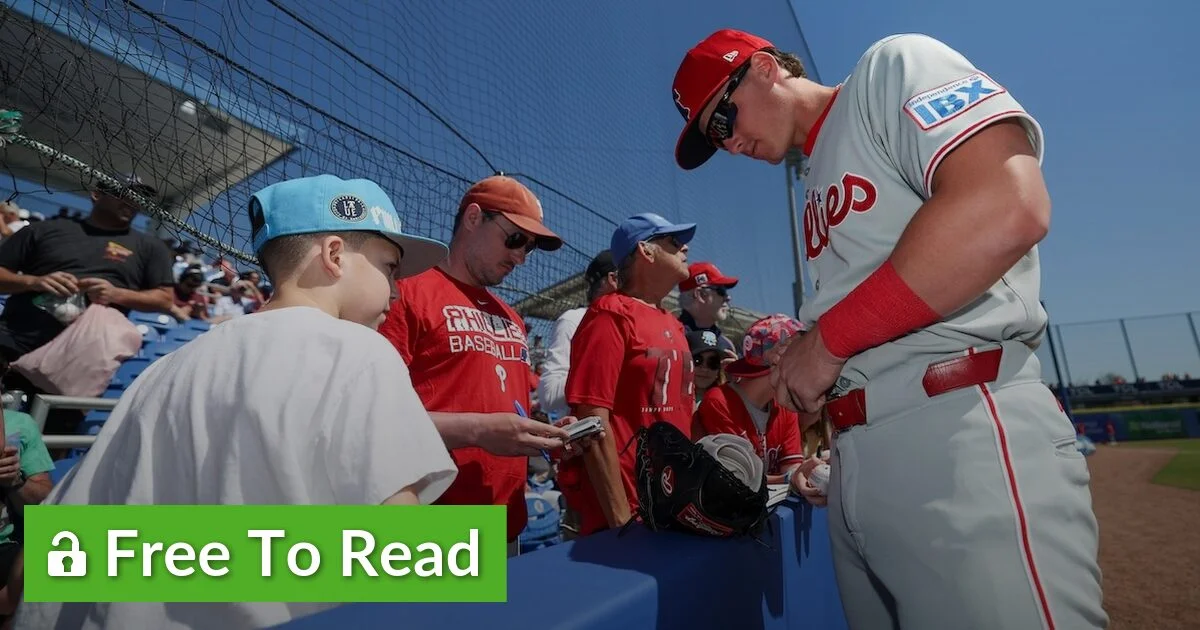
For Philadelphia Phillies prospect Aidan Miller, the next step toward the majors depends as much on staying healthy as on his bat. A back injury cut short a season that had put the 22-year-old within reach of a big league debut. Now, in the Arizona Fall League, he’s rebuilding his routine with a clearer limit on how much work he does.
The Phillies selected Miller 27th overall in the 2023 draft out of a New Port Richey, Florida high school. Before the injury, he had made a strong case for a rapid climb: in 2025, he posted a 137 wRC+ across Double-A Reading and Triple-A Lehigh Valley, hit 14 home runs and stole 59 bases. All but 37 of his 526 plate appearances came at Reading. He entered 2026 as the top name on FanGraphs’ Phillies Top Prospects list, carrying a 55 FV grade.
A season interrupted
Miller’s lower back problem was diagnosed as discogenic pain and facet inflammation in the lumbar spine. After the condition worsened, he underwent radiofrequency ablation in early June and played only eight games for the rest of the season, including four in Reading’s Eastern League playoff run.
He told me the long layoff was harder than expected, but it changed how he thinks about practice. Miller had often gone back to the cage after games, especially when he felt he hadn’t hit well. He says his hitting coaches have helped him recognize that adding swings isn’t always the answer.
“I love swinging, but I need to know when to dial back so that I can keep my body healthy,” Miller said. “It’s definitely more about quality than quantity.”
The extra work wasn’t always intended to fix his mechanics. Miller described it as a way to put the game behind him: alone with a tee, he could swing instead of replaying the day in his head. “It was my therapy,” he said. His account points to a useful distinction for a young hitter: practice can settle the mind, but that doesn’t mean more repetitions are always worth the physical cost.
Training with purpose
Miller’s pregame work remains varied, but each drill has a specific focus. He starts with a short bat and a Flamingo drill, bouncing on his rear leg to work on hip position and direction. He then moves to his regular bat for hard and soft flips, which challenge him to maintain posture without knowing what delivery is coming.
Machine work lets him tailor the session to the pitcher he expects to face. He uses foam balls and angled settings, including a low arm slot when preparing for a left-hander with that release. “I like to train tough,” he said.
During rehabilitation, he also faced machine simulations of major league pitchers, including Paul Skenes and Tarik Skubal. The first few weeks were rough, Miller said; he managed perhaps two or three hits. But he valued the chance to see their pitches and arm angles, calling it the closest thing to a real game.
That kind of preparation fits his view of his own swing. Miller agrees with Eric Longenhagen’s assessment that he handles high fastballs well, and says he generally hits fastballs effectively. He describes his swing as getting into the hitting zone early and working “more on-top,” with a preference for line drives through the middle. FanGraphs currently ranks him 26th on The Board.
Miller’s return in Arizona offers a chance to get back into game action after a year defined by injury and rehabilitation. The clearest adjustment may be in how he measures preparation: fewer swings can still mean better work, provided each session has a purpose and leaves his back ready for the next one.


