The Arizona Fall League offered a useful snapshot of prospects whose tools are already translating and others whose next step depends on refining a specific part of their game. Across eight games, Yankees shortstop Dax Kilby made the strongest case as an all-around standout. Elsewhere, the week brought a mix of impact power, premium speed and defensive experiments that will need more time to judge.
Kilby sets the pace
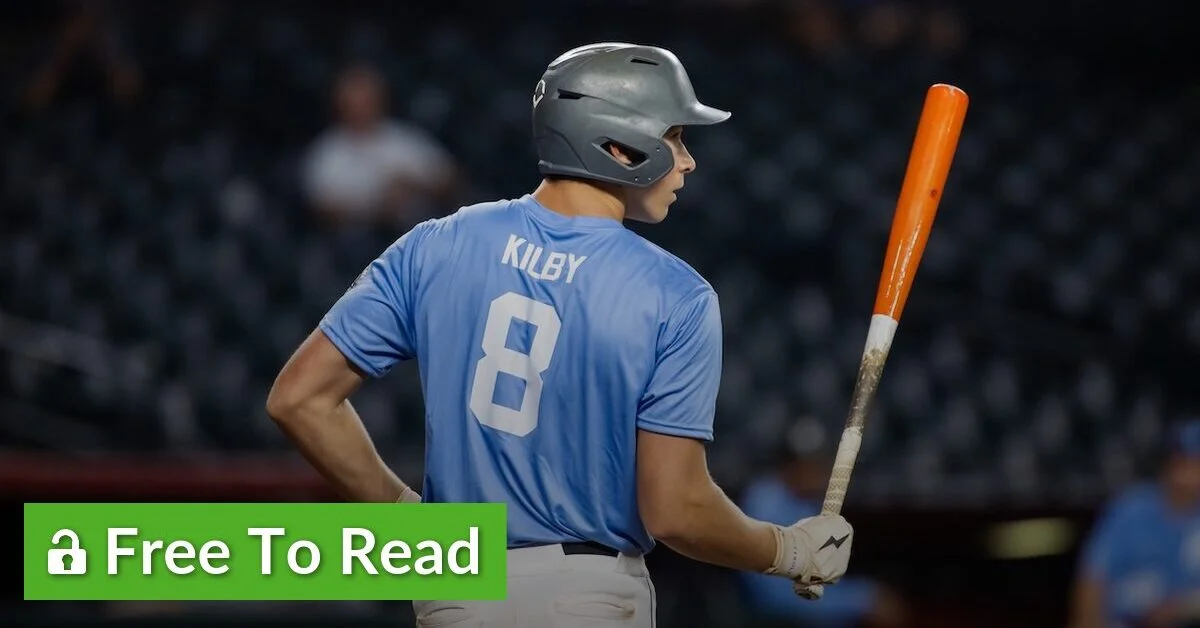
Dax Kilby, SS, Yankees
Kilby’s hitting stands out for how little he gives away. His hands work quickly and directly, his body stays controlled, and his swing remains on plane long enough to cover a broad range of pitches. He adjusts to velocity and can drive the ball to different parts of the field. When a fastball gets in on him, he can pull his hands in and still turn it around, a skill that recalls the hitting ability of Max Clark and Kevin McGonigle.
There’s substance behind the offensive impression. At shortstop, Kilby moves smoothly, covers ground and appears to understand how much time he has on a play. His throwing motion can look deliberate when he isn’t rushed, but he can speed up and make a quick release when the situation demands it. He looked like the most complete player on the field, and his showing raised his stock during the week.
Power with questions attached
Arjun Nimmala, SS, Angels
Nimmala’s offensive performance held steady, with both misses and encouraging contact. He struck out several times, but also hit the ball hard, including an opposite-field home run off a slider. That swing was particularly revealing: earlier in the at-bat he had missed a similar pitch, then adjusted and got the barrel to it. He has added bat speed as he has matured, helping him make better use of a long swing designed to lift the ball. More strength could raise the ceiling further.
His shortstop defense is a less comfortable fit. Nimmala has soft hands and a strong arm, but he lacks the quickness shown by some of the position’s other prospects. His routes and footwork can look labored. It’s too early to rule out shortstop, but a move to third base increasingly looks like a plausible outcome—and perhaps one the Angels may need to consider sooner than later.
Caleb Bonemer, OF, White Sox
Bonemer doesn’t have a fluid swing. His hands start from a standstill, and the path to the ball can look long and stiff. Yet the results show why the raw power deserves attention: he squared up three pitches at 104 mph or harder in the games watched. His power could grow to an elite level, and even a hitter with some mechanical rough edges can do damage if he keeps finding the barrel.
Bonemer is getting a look in center field this fall, where the learning curve has been visible. On one line drive, he broke in, had to retreat, and couldn’t recover before the ball glanced off his glove. A difficult first exposure can explain some of that, but his speed and overall athleticism may also make a corner outfield spot a better long-term match. The rest of the AFL schedule should show whether he gets opportunities there.
Wyatt Sanford, SS, Pirates
Sanford’s speed is an obvious carrying tool. He ran 4.15 seconds to first and showed a quick first step on a sinking ball over his head. He also runs the bases aggressively, sometimes past the point of good judgment: he was thrown out twice, including on an attempt to take second after an outfielder appeared distracted. Sanford hesitated and ended up caught in a rundown. On defense, that range helped him move in both directions, and his arm gives him a chance to develop into a plus defender at shortstop.
The bat offers power and volatility in equal measure. Sanford has added substantial strength since high school, taking his projected power from below average to plus. He can punish pitches down and in, but his setup and timing remain unusual. He leans forward with his back side elevated, and although a small hand load helped him stay balanced in this look, that hasn’t always happened. He can also be beaten above the zone and has trouble adjusting to breaking pitches. The ingredients are compelling; the contact risk makes him a high-variance prospect.
Position changes and swing decisions
Charles Davalan, UTIL, Dodgers
Davalan, who played only the outfield at Arkansas and in the Dodgers system, is trying second base in the AFL. His range looks adequate: he moved well to either side and made a full-extension dive on a ball up the middle that seemed out of reach. He also has enough arm. The question is whether his instincts and footwork will catch up. On one routine grounder, he moved backward instead of charging and nearly let the batter reach safely. That could be a matter of unfamiliarity, or a sign that the infield will remain a work in progress.
At the plate, Davalan showed a good feel for the barrel despite swinging with plenty of force. His power looks modest but can sneak up on a pitcher.
Eduardo Quintero, OF, Dodgers
Quintero is an explosive athlete with quick hands and plenty of bat speed. The top half of his swing is promising: he loads naturally, gets the barrel moving directly and can add loft when he catches the ball cleanly. His head generally stays on the pitch through contact. The lower half is less settled. He drifts away from the plate, opens early and can react sharply to breaking balls that start near him. A large scissor kick also helps power the swing, but can leave him off balance.
Quintero made contact with pitches on the outer part of the plate, a sign of useful barrel awareness, but those swings lacked authority. The concern is that pitchers could exploit both that outer edge and his early reactions to breaking pitches. His hands give him a foundation; the timing and balance will determine how often that foundation turns into damage.
Elite speed needs time to translate
Braylon Payne, CF, Brewers
Payne may be the AFL’s best athlete. He has exceptional speed once underway, quick wrists and a compact build that helps him get the bat into the hitting zone quickly. There’s already plus power, too. His swing is unconventional: from an upright, slightly closed stance, he rotates his front hip open and sometimes takes a steep path down to the ball. The shape isn’t pretty, but his contact has held as he has climbed through Milwaukee’s system. That gives reason for patience while he learns to manage it.
His speed hasn’t yet turned into consistently strong center-field defense. On a ball over his head, he turned the wrong way and chased it instead of running toward the landing area before adjusting. Still, the raw quickness gives him a strong chance to stay in center, even if his reads are merely adequate. For Payne, the upside is obvious; so is the need for time.
Tai Peete, CF, Cardinals
Peete combines plus speed and power with the energy to make an otherwise quiet fall game feel lively. He has become more capable of tracking balls in center field, and his enthusiasm shows up in everything from aggressive challenges to eye-catching athletic plays. When a teammate’s glove went over the wall while trying to rob a home run, Peete was the one who vaulted over to retrieve it.
His bat delivered encouraging moments during the week. Spin remains a problem, but he drove a hanging breaking ball out of the park and lined a couple of fastballs hard to the opposite field. Like Payne, Peete has maintained a contact rate that remains concerning but workable as he has reached Double-A. His athleticism makes it reasonable to give him room to adjust.
Nathan Hall, OF, Diamondbacks
Hall made a strong impression over repeated looks. He’s tall and lean, with more strength than his frame suggests: one ball left his bat at 109 mph, and his bat speed is above average. He also showed a patient eye, drawing several walks, and did a good job adjusting to fastballs and getting to a couple of breaking pitches.
The defensive picture is less settled. Hall read routine flies well in center, but appeared less comfortable in left. The difference may have come from starting in a less familiar outfield position; the AFL is also using experimental alignments at Salt River Field, covered in Eric’s reporting. Hall has the speed to cover center, but his outfield reads warrant another look before assessing his place on Arizona’s prospect list.
Vance Honeycutt, CF, Orioles
Honeycutt has power and bat speed, though strikeouts remain part of the profile even after better contact at Double-A. His high leg kick can leave him out in front of softer pitches, and the uphill path of his swing creates a target above the barrel. There was a defensive benefit to the AFL’s closer outfield positioning: he had to cover several long fly balls and ran extensively. Honeycutt showed good instincts and clean routes. His throws, by contrast, often came up short or missed their target.
Smaller notes with useful signals
Mason White, INF, Red Sox
White split time between second and short. He handled routine chances at shortstop and has enough arm for the position, but appeared more comfortable at second, where he had time to complete a play without rushing. A solid stop to his right at the keystone showed the difference: the extra beat to transfer and throw helped him work at his own pace.
Jake Munroe, 3B, Angels
Munroe has continued to win over the observer despite limited raw tools: below-average power, average arm strength and 40-grade speed. His bat control and pitch recognition are the draw. He tends to drive fastballs hard the other way and does more pull-side damage when off-speed pitches stay out over the plate. He’s serviceable at third, and the Angels could test him at other positions as they explore a multiposition role. His ability to hit is the clearest reason to keep watching.
A few shorter observations round out the week. Bryce Rainer has one of the quickest bats seen from a minor leaguer. Andy Perez swings so often that a Royals scout compared his frequency to Salvy’s; dialing back his aggression could help his contact skills carry more value. Core Jackson struggled to stay balanced against spin. And though there was only one look at Julian Brock, Salt River tried to run on him seven times. His throws generally landed in the right place, and his release times were consistently between 1.90 and 1.95 seconds.
The clearest takeaway from the week is that the AFL can sharpen a prospect’s outline without settling every question. Kilby paired advanced hitting with steady shortstop play; several others showed standout tools alongside specific areas that need work. The next useful signal will be whether those strengths hold as opponents adjust and players get more chances at unfamiliar positions.


