The best Division Series don’t just deliver one famous swing or a dramatic final night. They make every game feel consequential. That distinction came to mind after Milwaukee and San Diego packed a walk-off, a home run robbery, and a comeback win—plus two paternity leaves—into a series that deserved a fifth game. It was a terrific matchup. The harder question: how often has a Division Series been that good from start to finish?
The modern Division Series began in 1995. A one-year version had appeared in 1981 after a players’ strike, then disappeared until the next strike helped make the format permanent. Since 1995, 128 Division Series have been played: 41 ended in sweeps, while 39 reached a winner-take-all Game 5. The White Sox-Guardians series still in progress would be the 40th to go the distance.
Those numbers tell you how often a series ends quickly or goes to the brink. They don’t tell you whether it was any good. Short series can turn into mismatches, especially when established contenders meet teams ahead of schedule. But baseball’s small samples also give underdogs room to make the gap between teams look surprisingly narrow. In 2023, the 100-win Dodgers and 101-win Orioles were both swept out by the decade’s most unexpected World Series participants. Even a sweep can be tense: in 1996, San Diego put the tying run at the plate in the ninth inning of all three games against St. Louis.
This ranking is stricter than a highlight reel. A single iconic performance—Pedro Martínez throwing six dominant relief innings, or Todd Pratt hitting an improbable home run—can define a moment without making the whole series memorable. The same goes for a spectacular deciding game that follows several lopsided ones. Howie Kendrick’s 2019 grand slam against the Dodgers is unforgettable, but the Nationals-Dodgers series had an average winning margin of 4.6 runs. The 2021 Dodgers-Giants series gave us Max Scherzer’s only career save and a check-swing argument for the ages; its games were still decided by four, five, and seven runs.
For a series to earn a place here, the tension has to hold across multiple games. Star power helps; so does a strong story. Here are the ten best Division Series, counting down.
10. All of 2012
One year gets a group entry: 2012, the only season when all four Division Series went to five games. The shorthand alone captures the October mood: Buster Posey’s grand slam, the Pete Kozma game, the Raul Ibanez game, and Justin Verlander facing Oakland. Four series, four deciders. That’s a week of baseball worth remembering.
9. 2016 – Dodgers beat Nationals 3-2
By 2016, the familiar postseason doubts around Los Angeles had become hard to ignore: Clayton Kershaw supposedly couldn’t deliver in October, and the Dodgers’ bullpen looked even shakier. The team had been eliminated in the Division Series in each of the previous two seasons. Its first-year manager, Dave Roberts, inherited a club with plenty to prove.
Kershaw quieted the conversation for a night by outdueling Scherzer in Game 1. Then Washington won the next two, including a game in which Kenley Jansen gave up four earned runs. The rest of the relief corps tells a more complicated story: Luis Avilán, Pedro Báez, Joe Blanton, and Grant Dayton each appeared at least three times. Avilán, Báez, and Blanton didn’t allow an earned run. Dayton nearly gave the series away.
In Game 5, Los Angeles led by three when Dayton came in for the seventh against the bottom of Washington’s order. He walked Danny Espinosa, surrendered a pinch-hit homer to Chris Heisey, then gave up a single to Clint Robinson. Roberts answered by turning to Jansen and Kershaw for the final nine outs. Kershaw finished the game—and earned the only save of his major league career—after entering with the tying run in scoring position. It was a gutsy, effective answer to years of postseason criticism. And the Dodgers might not have reached that Game 5 without Chase Utley’s series-saving hit in Game 4.
8. 2017 – Yankees beat Cleveland 3-2
The 2017 Yankees are still the most recent team to lose the first two games of a Division Series and come back to win it. Cleveland may yet change that, but at the time the deficit made every remaining game urgent. New York started its climb with seven shutout innings from Masahiro Tanaka and a left-on-left homer by Greg Bird off a reliever who seemed nearly unhittable.
Luis Severino delivered the best outing of his career to take Game 4. In Game 5, Didi Gregorius hit two home runs off Corey Kluber, who would win his second Cy Young Award that season. There was plenty more: Aaron Judge struck out 16 times, a Division Series record, and Cleveland made nine errors in five games. Still, Game 2 is the series’ centerpiece: Cleveland beat New York 9-8 in 13 innings. It’s one of the century’s great games, and Francisco Lindor’s grand slam is the kind of moment that can make you feel capable of lifting a house.
7. 2011 – Cardinals beat Phillies 3-2
The 2011 Phillies looked built to win in October. Their famous Four Aces rotation—Roy Halladay, who started twice, Cole Hamels, Cliff Lee, and Roy Oswalt—made every start. The offense still had its championship core, though the players were aging. Ryan Madson had filled in well for injured closer Brad Lidge, and Philadelphia had played in each of the previous four postseasons.
The Cardinals’ answer was depth in unexpected places. Skip Schumaker and Ryan Theriot mattered as much as the bigger names. Albert Pujols hit .350, while Yadier Molina threw out three would-be base stealers and guided the pitching staff through Philadelphia’s lineup. Schumaker and Theriot went 12-for-20 together, with four doubles and four RBI. The biggest hit came in Game 5: Schumaker drove Halladay’s 10th pitch of his first at-bat into the right-field corner. It proved to be the game’s only run.
That decisive game is remembered for Chris Carpenter’s complete-game shutout and for Ryan Howard tearing his Achilles on the final play—a devastating end to Philadelphia’s run of success. But the series had built its tension over several games. Three were decided by one run, including Game 2, when St. Louis rallied from a 4-0 deficit to beat Lee, and Game 3, which stayed scoreless until Ben Francisco hit a pinch-hit homer in the seventh.
Philadelphia won the opener 11-6. After that, every game had the feel of an event.
6. 1997 – Cleveland beats Yankees 3-2
The defending champion Yankees met a Cleveland team in the middle of its own ’90s resurgence. The series wasted no time getting strange. In Game 1 at Yankee Stadium, Cleveland scored five in the first inning off David Cone. Then the Yankees put up five in the sixth, including three consecutive home runs—the first time a postseason team had hit back-to-back-to-back homers.
Cleveland roughed up Andy Pettitte to take Game 2, then dropped Game 3 at home. That left two elimination games, both in Cleveland because of the playoff format at the time. The hosts won each by a single run. In Game 4, with Cleveland four outs from elimination, Sandy Alomar Jr. homered off Mariano Rivera to tie the game in the eighth. Omar Vizquel won it with a ninth-inning walk-off.
There was still a Game 5. Jose Mesa recorded the save after allowing a runner to reach second, another small reminder that nothing came easily. The roster had star power to spare: Derek Jeter, Rivera, Tim Raines, Wade Boggs, Bernie Williams, Jim Thome, Manny Ramirez, David Justice, and Orel Hershiser, among others. The names mattered, but the close finishes made the series.
5. 2015 – Blue Jays beat Rangers 3-2
The 2015 Toronto-Texas series felt charged from the first pitch. The Blue Jays were back in the postseason for the first time since winning the 1993 championship, ending the longest active playoff drought in baseball. You could feel the anticipation through the television broadcast at the pre-renovation Rogers Centre.
Then Toronto lost its first two home games. Texas scraped out runs with hits from Delino DeShields and Hanser Alberto. Game 2 took 14 innings and used 37 players. The two games in Texas that followed were comparatively quiet, which is the strongest case against putting this series among the best.
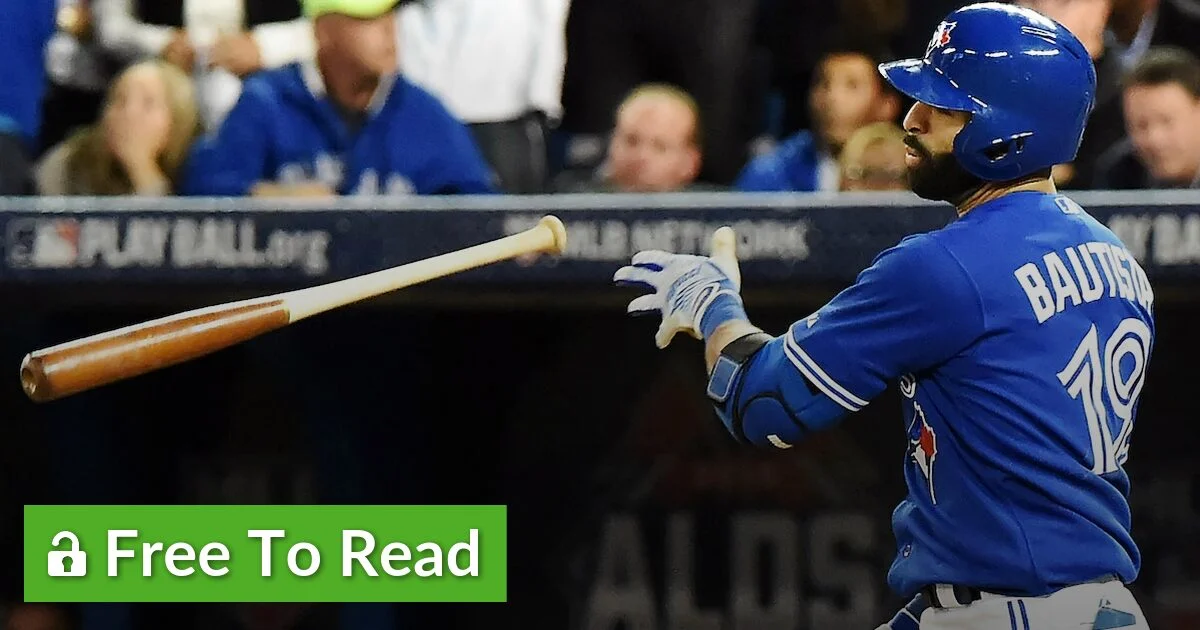
Game 5 answered that objection. José Bautista’s go-ahead homer—and the bat flip that followed—became a defining image of the series and helped bring bat flips into the mainstream. The game also supplied a baseball rule that caught plenty of viewers off guard: if a catcher throws the ball back to the pitcher and it hits the batter’s bat, the ball remains live.
4. 2001 – Diamondbacks beat Cardinals 3-2
Arizona and St. Louis alternated wins, every game was decided by three runs or fewer, and the series ended on a walk-off. That’s a strong case for an all-time Division Series.
The Diamondbacks won despite being outscored 12-10, and despite losing the only game started by Randy Johnson. St. Louis, meanwhile, hit just .191 and leaned heavily on a bullpen that had no clear ace and hadn’t been especially strong during the regular season. The results don’t fit a tidy script. That’s part of the appeal.
Curt Schilling’s case as the greatest Division Series performer rests on a staggering workload and one pitch he’d rather have back. He threw nine innings in both of his starts, striking out nine and allowing three hits and no runs in Game 1. In Game 5, he struck out nine again. His 18 innings set a Division Series record, as did his 1.30 Win Probability Added for the series. The blemish was a pitch left over the plate to J.D. Drew.
That mistake helped set up Tony Womack’s series-ending floater, a preview of his later postseason heroics. For a neutral viewer, it was a pretty good trade: one costly pitch, then a finish worth remembering.
3. 2003: Red Sox beat Athletics, 3–2
The 5–1 Game 2 looks like the dud in the box score. Watch it, though, and you get seven innings of Barry Zito at his best. His outing put Oakland in control, but the A’s couldn’t close the series: Boston won the next three. Trot Nixon started the comeback with a walk-off homer.
The following day, Oakland carried a lead into the eighth and asked Keith Foulke to get the last six outs. He retired the first two hitters. Then David Ortiz doubled in two runs.
Oakland still had Zito lined up for Game 5, but Boston countered with Pedro Martínez. Zito left Manny Ramírez a hittable 86-mph pitch down the middle, and the Red Sox took another tense game. The loss extended Oakland’s run of four consecutive ALDS Game 5 defeats, from 2000 through 2003. The A’s had won the first two games in two of those series, including this one. For East Bay fans, that’s a brutal pattern. For everyone else, it made for a postseason full of drama. Oakland’s consolation: Ramon Hernandez’s strange, effective two-out walk-off bunt in Game 1.
2. 2013: Tigers beat Athletics, 3–2
Every game in this series found a new way to tighten the screws. Game 1 paired Max Scherzer with Bartolo Colon and ended with Joaquín Benoit needing to get past Brandon Moss and Yoenis Cespedes. Game 2 stayed scoreless into the ninth, thanks to Justin Verlander and Sonny Gray, before little-known catcher Stephen Vogt ended it with a walk-off single. In Game 3, Grant Balfour and Victor Martinez turned a confrontation into a shouting match for the cameras.
Then came Game 4. Detroit fell behind 3–0, fought back, trailed 4–3, and still won. The tying homer by Martinez was reviewed over possible interference.
Max Scherzer relieved Doug Fister in the seventh with the score tied. Oakland used small ball to move ahead, and Detroit answered in the same inning. In the eighth, Scherzer loaded the bases with nobody out, struck out two, then went to a full count against Alberto Callaspo. Callaspo hit a liner that hung in the air long enough to be caught. One more inch of trouble could have changed the series; the game felt like a powder keg.
Verlander took over the story in Game 5, shutting Oakland down. He was one of five pitchers to finish an LDS with a 0.00 ERA over at least 10 innings. That’s the lasting point: the Tigers’ advancement came through a string of close calls, but Verlander’s finale was pure command.
1. 1995: Mariners beat Yankees, 3–2
The 1995 series sits at the center of the Mariners’ story, and Ken Griffey Jr.’s sprint around the bases to win Game 5 remains an all-time image. But that finish only makes sense with the chaos that came before it.
Griffey hit two home runs off David Cone in Game 1. Seattle still lost after reliever Bobby Ayala gave up three runs. In Game 2, Vince Coleman, a career .345 slugger, hit a home run during a game that lasted more than five hours. Jim Leyritz ended it with a walk-off homer, a gut punch for Seattle baseball.
The Mariners won Game 3, then came back from five runs down to take Game 4. Edgar Martinez is remembered for his Game 5 double, but he’d already delivered two home runs the day before. Keeping the first one fair was a feat in itself.
Game 5’s heroes need no introduction: Martinez drove in the winning run, and Griffey raced home. The supporting details make the game even stranger. Cone threw 147 pitches. New York managed six hits but drew 10 walks. And rookie setup man Mariano Rivera logged his third straight scoreless outing, finishing as the series leader in Win Probability Added.
Five games, each close and high-scoring, made this series hard to reproduce and easy to remember. Its place at the top of this list feels earned: the famous final play was the payoff to a week of pressure, reversals, and near misses.


