Baseball can spend hours building suspense, then erase it in half a second. That’s the uneasy bargain at the center of a day when the eight remaining teams scored 17 runs, with 13 coming on home runs. A ball leaving the yard can settle a game before the fielders have time to react, turning a long contest into a before-and-after story.
The home run has a peculiar relationship with drama. Football can stretch a pass through the air while players race into position; basketball lets everyone watch a three-pointer arc toward the hoop. A deep fly ball can offer that same uncertainty if an outfielder is racing the wall. But when a hitter has squared it up and the ball is plainly gone, the suspense evaporates. The moment lands less like a slow reveal than a sudden jolt.
That was the shape of Cleveland’s afternoon. Co-ace Parker Messick had settled in after an uneven start, retiring seven straight hitters before Miguel Vargas opened the fourth with a single. Then Munetaka Murakami came to the plate. Messick delivered, and almost immediately the game’s direction seemed settled.
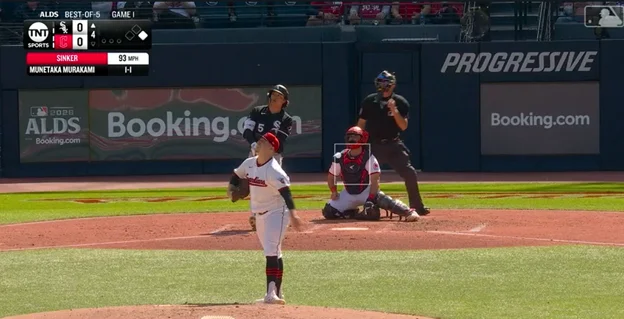
There was no close call at the fence. Chase DeLauter took two unhurried steps toward the wall, then stopped as the ball dropped into the stands. No race, no leap, no chance for the crowd to bargain with the flight of the ball. A season can spend six months accumulating meaning, only for one swing to cut through all of it without warning. The ending is so quick it barely leaves room for an emotional postscript.
Games that wouldn’t break open
Still, baseball rarely lets anyone leave when the decisive moment arrives. Cleveland and Messick spent the next six innings waiting for their offense to answer. The reply never came. Elsewhere, the Dodgers and Braves traded blows without building much momentum, each side managing only intermittent bursts of offense. A day dominated by home runs also made clear how difficult it can be to manufacture a response once a game narrows to one run.
The matchup between Drew Rasmussen and Gerrit Cole in New York offered another version of the same problem: a potentially memorable pitchers’ duel, interrupted by one well-timed hit. Cole’s delivery looked almost casual, a quality that can seem odd in a sport where position players sometimes take the mound with similar ease. But the pitch itself had real precision. His changeup faded toward the outer edge of the strike zone, close to ideal.
With two strikes, though, Jonathan Aranda had reason to go after it. He drove the ball hard to right-center, producing the only run the Rays would need and the only run they would score. A pitch that might have passed untouched earlier in the count became a swing worth the game. The margins were narrow; the result was not.
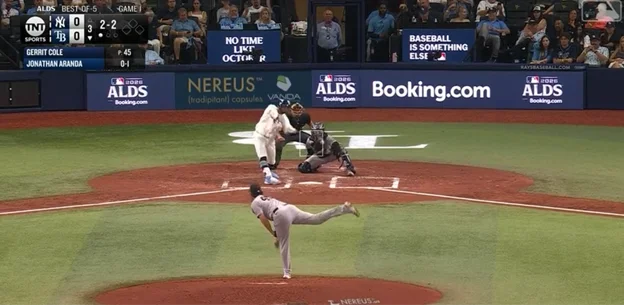
The Yankees, meanwhile, waited six innings for one swing of their own. When Austin Wells finally sent a line drive down the third-base line in the eighth, it was New York’s first hit of the game. Wells kept running, trying to stretch the hit into a double. He ran straight toward the waiting glove of Junior Caminero at third.
Wells later said he was “trying to make something happen.” The explanation doesn’t make the decision look much better. Manager Aaron Boone called it “obviously, not a good decision there,” and Rays shortstop Taylor Walls said he “just couldn’t believe it in my head.” Yet the impulse is easy to recognize. When a team has gone hitless for most of a game, one baserunner can feel like the only available opening. In a contest where the home run seems impossible, a desperate gamble starts to look like a plan.
A ball suspended between outcomes
The evening in Milwaukee brought the day’s oddest turn. San Diego’s eighth and ninth hitters drove in runs with ground balls against the Brewers’ ace, briefly making chaos look possible. Then Jacob Misiorowski found his footing and retired his final seven batters. Milwaukee’s rested bullpen did its job, buying the lineup enough innings to move ahead with two home runs. The Padres needed just one swing to answer.
For a moment, Ty France seemed to provide it. His fly ball to left came off the bat at 105.3 mph and a 49-degree launch angle. Those numbers offer plenty of room for imagining alternate outcomes: an open roof, a different bounce, a ball that carried into foul territory, or one that fell short. They also sharpen the peculiar uncertainty of a ball that might be fair, foul, caught, or gone depending on the park and the rules that govern it.
Statcast has made it easier to picture a home run at the instant of contact. Launch angle and exit velocity can suggest what the ball should become, before its flight has finished. But the numbers don’t change what happened on the field. France, Trevor Megill, and everyone watching had to wait for the ball to come down and for the play to be judged.
That pause made the moment stranger, and more absorbing, than the day’s clean home runs. The ball seemed to belong to several possible versions of the game at once. For a few seconds, nobody knew which version would hold: the ball might have been a home run, or it might not. The uncertainty was brief, but it gave baseball something a clear shot into the seats can’t supply: time to wonder.
Then the ball came down, and the possibilities collapsed into one result. That’s the sport’s particular cruelty and pleasure. A season can hinge on a swing, a baserunning decision, or a ball hanging in the air just long enough for everyone to imagine what comes next.


