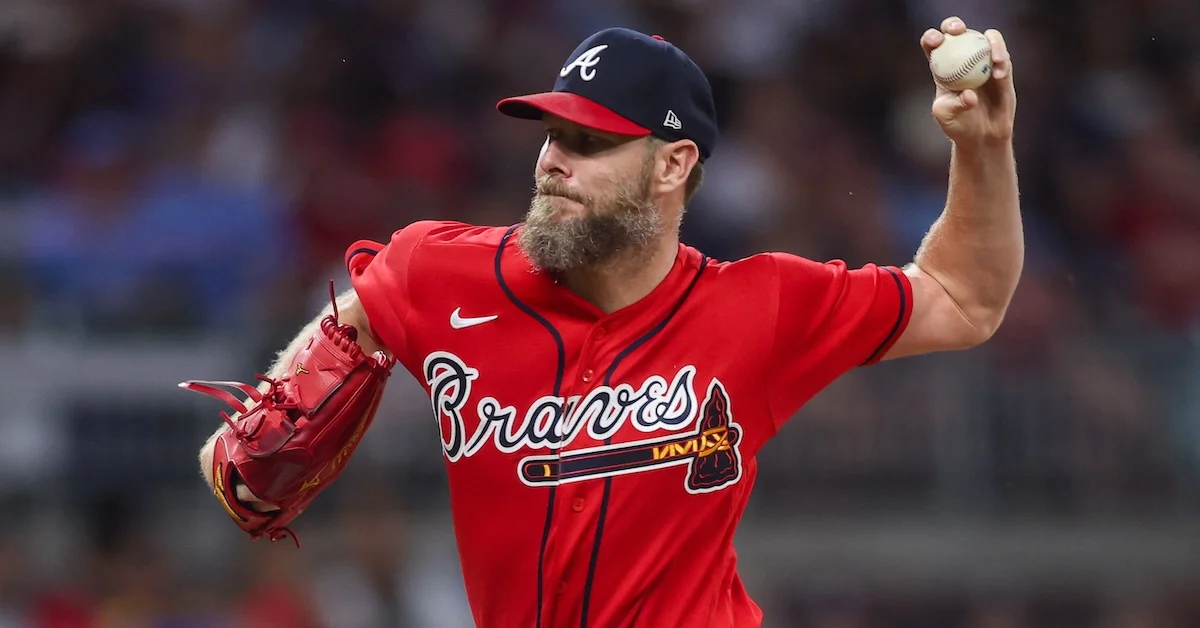
Atlanta’s decision to summon Chris Sale for four outs in a four run lead came with a larger price than the moment suggested: the Braves lost a planned start from their ace in the National League Division Series. My read is that manager Walt Weiss prioritized the game in front of him without giving enough weight to what Sale could have done in the rounds ahead.
That choice didn’t doom Atlanta. The cost, in the article’s estimates, amounts to a few percentage points of series win probability, and the Braves split their first two bullpen games against the Dodgers. But a small probability shift can still be a poor trade when the immediate reward is so limited. Sale had already helped Atlanta through the Wild Card opener; using him again on one day’s rest in a comfortable lead put his availability for the next series at risk.
A relief appearance that reshaped the rotation
Sale’s postseason began with a 95 pitch start against Philadelphia in Wild Card Game 1. He left in the seventh inning with two runners on and one out, as the bottom of the Phillies’ order approached. Didier Fuentes allowed both inherited runners to score, but Atlanta recovered and won. After Philadelphia took Game 2, the series came down to a decisive third game. Weiss then called on Sale to record the final four outs.
Sale entered with two outs, nobody on base, and Atlanta leading by four. He retired Bryce Harper to finish the game. The immediate result was clean. The scheduling consequence was not: Sale had been expected to start NLDS Game 2 against Los Angeles on four days’ rest, but the 21 pitch relief outing left him unavailable. His next start moved to Game 3.
There was a broader opportunity cost. Under the original schedule, Sale could have started NLDS Game 2 and, if the series went five games, started Game 5 on regular rest. That path also positioned him for two starts in a possible Championship Series and two in the World Series. The alternative plan kept him on the mound in the Wild Card clincher, then shifted his later starts earlier in each round.
| Playoff Start | Baseline Plan (Game, Days Rest) | Weiss Plan (Game, Days Rest) |
|---|---|---|
| 1 | WC G1 | WC G1 |
| 2 | NLDS G2, 4 | WC G3, 1 (Relief) |
| 3 | NLDS G5, 4 | NLDS G3, 4 |
| 4 | NLCS G3, 4 | NLCS G1, 4 |
| 5 | NLCS G7, 4 | NLCS G5, 4 |
| 6 | WS G2. 4 | WS G1, 6 |
| 7 | WS G6, 5 | WS G5, 4 |
The comparison frames the decision starkly: Atlanta exchanged a potential Sale start for four relief outs. He was scheduled to pitch frequently in either path, including twice in each of the later rounds. But the starting role offered a chance to cover a full game against the Dodgers, while his relief appearance addressed a short stretch in which Atlanta had a substantial cushion.
The leverage didn’t match the cost
In the actual Wild Card situation, a replacement-level bullpen option was unlikely to give up four runs in four outs. A simulation using Brent Suter gave Atlanta a 98.6% chance of winning; with Sale, the estimate rose to 99.3%. Sale was clearly the better pitcher, but the difference between those win probabilities was less than one percentage point.
The missed NLDS start carried more weight. FanGraphs’ ZiPS game-by-game odds put Atlanta’s chance of winning a potential deciding game at about 10 percentage points higher with Sale facing Tarik Skubal than with a bullpen game. A simulation of the NLDS, starting from a 40% chance of winning with two Sale starts, estimated that losing the second start would cost Atlanta about 3.5 percentage points in its chance to take the series.
That’s a meaningful gap, though hardly an insurmountable one. The Braves could still win with their other pitchers, as their Game 2 effort against Los Angeles demonstrated. The question is what Weiss was giving up at the time of the decision. A potential Sale start in a five game series was a significant asset; four outs in a game Atlanta was already overwhelmingly favored to win were not worth as much.
There is a version of the argument in which using Sale makes sense. If Philadelphia had left Atlanta with a one run lead in a winner take all game, Sale’s presence could have raised the Braves’ Wild Card win probability by about seven percentage points. Under that scenario, the extra chance to advance roughly offset the later cost of losing a Sale start.
| Plan | WC Win Odds | NLDS Win Odds | Odds of Winning Both |
|---|---|---|---|
| Baseline | 84.5% | 40.0% | 33.8% |
| Weiss | 91.3% | 36.6% | 33.4% |
Those estimates show how strongly leverage changes the calculation. With a one run margin, an elite pitcher could protect a fragile lead and materially improve Atlanta’s immediate odds. With four runs in hand and nobody on base, the potential gain was much smaller. The context around Sale’s entry matters more than the fact that the game was an elimination game.
Workload management cut both ways
Atlanta had spent the regular season carefully managing Sale. He made only three starts in September, and after his second and third outings of the year, he never again started with fewer than five days’ rest. That caution made sense given his age, his injury history, and what happened in 2024: Sale won the Cy Young Award but missed the postseason after suffering a back injury in September.
The Braves may have viewed that history as a reason to preserve Sale for October. Yet calling on him after just one day’s rest undercut the plan. Sale had thrown 100 or more pitches 12 times in the regular season, including four of his final seven starts. In the Wild Card opener, Weiss removed him after 95 pitches with Edmundo Sosa and J.T. Realmuto due up. If the manager trusted Sale enough to use him again on short rest, leaving him in to face the bottom of Philadelphia’s order may have been the more consistent choice.
Weiss told reporters that he and Sale discussed the possibility earlier in the day after Sale said he “felt amazing.” The relevant decision likely came in the middle innings, when Weiss would have needed to tell Sale to start warming up. Atlanta led by five after the fourth and four after the sixth. Modeling the choice from either point, using Sale instead of the bullpen was worth 1.7 percentage points of Wild Card win probability—more than the estimate for the actual entry point, but still well below the value of the lost start.
That points to a tension in Atlanta’s bullpen management. The Braves pulled Sale before he faced the bottom of Philadelphia’s order, apparently to get preferred relievers into the game. Then, with a large lead, they used an older, workload-managed starter in an unfamiliar relief role because they were wary of the available bullpen options. A team can choose to protect its best relievers for high leverage, or it can ask its starter to work deeper. It’s harder to justify both choices when they combine to push an ace into a short-rest appearance.
The present has a price
Postseason decisions are made with incomplete information, and Atlanta couldn’t know how the game would unfold or whether a reliever would give up the lead. Risky choices sometimes pay off. Sale did his job, and the Braves advanced. The critique is about the expected value of the decision, not the result.
Sale’s outing added a small amount to Atlanta’s chance of winning the Wild Card game while removing a valuable start from the next round. Those odds are estimates, not guarantees, and the difference between a 40% and 36.6% chance won’t feel clear in any one series. Still, the direction is clear: the Braves accepted a lower chance against the Dodgers for a marginal increase in a game they were already positioned to win.
Atlanta’s decision could prove survivable, and the team already showed it can win without Sale in the rotation. But a postseason plan has to account for the next start as well as the next out. The useful takeaway from Sale’s deployment is simple: save a rare, high-value arm for the moments when his presence can change the game, and make the short-term call with the next round in view.


