The Gulf Stream’s recent acceleration adds another variable to how storm swells move across the western Atlantic. For surfers, the potential effect is real but indirect: the current can reshape waves already in motion, while the new findings don’t predict better surf or more storms. That distinction matters. A changing current can alter the conditions waves encounter without telling anyone when, where, or whether a useful swell will arrive.
A decade of change in the current
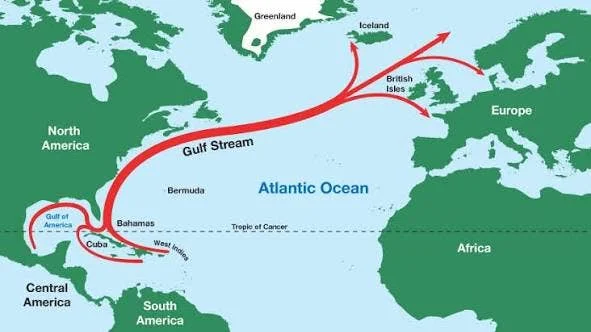
A new NOAA study tracked the free-flowing Gulf Stream downstream of Cape Hatteras using 31 years of satellite altimeter observations, from 1993 through 2023. Researchers found a prolonged weakening from 2005 to 2014, followed by rapid intensification between 2014 and 2023. The record therefore captures a reversal within the period studied, rather than a uniform trend across all three decades.
The current also shifted north and became more stable, with less meandering. The result complicates the familiar account of a steadily weakening Atlantic circulation. “The Gulf Stream’s story is far more dynamic than a simple slowdown narrative,” said NOAA oceanographer and study lead Shenfu Dong. The measured changes describe this section of the current over a defined period; they don’t, by themselves, settle what will happen next.
NOAA
The study concerns the current after it separates from the coast; it doesn’t show that the entire Atlantic circulation has accelerated. Upstream flow through the Florida Straits, NOAA says, remained relatively steady. That boundary is important because regional measurements can describe meaningful local change without serving as a verdict on the behavior of a larger ocean system.
What the current can do to waves
Currents can change the shape and direction of waves moving through them. When water flows against a swell, it can compress the waves and make them steeper. The Gulf Stream’s position and strength can therefore affect the wave field produced by storms as it travels toward the East Coast. The interaction depends on the direction of the flow relative to the waves, so a faster current alone doesn’t point to one predictable result.
Hurricane Matthew offered a measured example in 2016. Researchers found that the Gulf Stream created areas of steeper waves and changed incoming wave directions at the coast by as much as 20 degrees. The current didn’t generate those waves; it altered their path and form. This is more significant than it looks: a directional change offshore can influence where wave energy is aimed, even when the storm itself is the source of the swell.
Related: The 1983 El Niño Destroyed California’s Coast — Could It Happen Again? (Video)
A stronger, more northerly Gulf Stream could affect how storm swells cross the Atlantic, especially when they meet the current at an angle. The outcome would depend on factors such as the storm’s track, the current’s position, wind direction and seafloor shape. In some conditions, the change could mean steeper offshore seas or a slight shift in where storm energy reaches shore. For a surfer, that’s a chain of possible effects, not a reliable recipe for better waves.
That’s a mechanism, not a forecast. The NOAA study doesn’t establish that a faster Gulf Stream brings more hurricanes or that a slower one favors Nor’easters. The links between ocean currents, weather patterns, storm tracks and waves are too complex for that conclusion. Here’s the thing: knowing that one part of the system has changed still leaves the local forecast dependent on how several moving parts line up.
Heat, weather and a new Atlantic variable
The current’s changes matter beyond surfing. A faster Gulf Stream can carry more heat toward higher latitudes, warming the upper ocean and increasing the heat released into the atmosphere, NOAA said in a press release. Its strength and position also influence North Atlantic weather, sea levels, marine ecosystems and climate. Those connections make the current relevant to a broad range of ocean and atmospheric processes, though this study’s findings shouldn’t be stretched into claims about outcomes it didn’t measure.
Warm ocean water can supply energy to tropical systems, and shifts in storm behavior can change the swells they produce. Bigger storms may create more surf potential, but they can also bring greater destruction. The current’s recent behavior doesn’t settle how those effects will play out. The tradeoff is plain. More wave energy doesn’t mean better surf conditions or a safer coast.
Related: Atlantic’s Sargassum Problem Is Reaching Record Levels
What surfers should take from the findings
For East Coast surfers, the practical takeaway is modest: the Gulf Stream deserves a place among the variables that shape a session, alongside storm track, wind, fetch, swell period, tides and bathymetry. If you’re working in this space, the study gives useful context for interpreting how a swell may change on its way in, but it doesn’t replace local forecasts or observations. The satellite record shows a current that can weaken, accelerate and shift position over time. Whether those changes produce cleaner lines or steeper seas at a particular break will depend on how the current meets each storm’s swell.
And yet. The findings make a simple, useful point: the Gulf Stream isn’t a fixed backdrop to Atlantic surf. Its changing position and strength can alter the route and shape of waves, while leaving the timing and quality of any session uncertain. That’s a variable to watch, not a promise.


