Getty Images
American sporting exceptionalism has long defined the country’s relationship with men’s soccer.
The world’s most popular sport has traditionally struggled to gain a foothold in a market where American football is king and baseball is woven into the national identity. The 1994 men’s Fifa World Cup catalysed the creation of Major League Soccer (MLS), but the tournament’s legacy was slow-burning, and a men’s national team that never threatened the latter stages of major competition prevented the sport from being thrust into the limelight.
Indeed, many still regarded soccer as a “foreign” pursuit best played by women and children. But it was precisely this attitude that created opportunities for female athletes at college level and on the global stage.
The US women’s national team are one of the dominant forces in the international game, and their victory in the 1999 Fifa Women’s World Cup delivered American soccer’s most iconic moment. The image of Brandi Chastain removing her shirt in celebration adorned the front page of national newspapersy, catapulting the sport into the mainstream.
The triumph renewed calls for greater investment in women’s soccer, setting in motion nearly three decades of growth (with a few hiccups along the way) that have coincided with rising popularity of the sport in general.
MLS is now firmly established, coverage of foreign competitions has gone from the periphery of sports media onto network television, and the 2026 men’s World Cup in North America was a national event in a way that USA 94 was not.
According to Nielsen, the number of people in the US identifying as soccer fans jumped from 66.8 million in July 2025 to 75.2 million in July 2026. Over the past five years, the growth rate has been 26 per cent.
Now, women’s soccer is ready to take up the baton and build on that momentum for sport’s entire ecosystem in the US. Next year’s Women’s World Cup in Brazil kicks off a four-year cycle that includes a new National Women’s Soccer League (NWSL) broadcast deal, further expansion, the Los Angeles 2028 Olympic Games, and the 2031 Women’s World Cup in North America.

Brandi Chastain’s winning penalty in the 1999 Women’s World Cup is US Soccer’s most iconic moment (Image credit: Getty Images)
The NWSL’s growth trajectory
“I’ve always wondered when Americans are going to begin to pay attention to this sport of soccer that the rest of the world is enjoying,” NWSL commissioner Jessica Berman told the Leaders Week sports business conference in London.
“But the [appreciation for the] culture around the game, the respect for the game [and] the appreciation for the unique attributes of the game that we had in America around the World Cup gave me a lot of enthusiasm and excitement about the future.”
Along with the Women’s National Basketball Association (WNBA), the NWSL is the most high-profile professional women’s team competition in the US. Now in its 14th season, the league’s business is booming by almost every measure. Match attendances, TV viewership and franchise valuations have all climbed considerably in recent years amid growing fan and investor interest.
Commercial rights values have never been higher, while a historic collective bargaining agreement (CBA), agreed in 2024 and running until 2030, delivered better pay and working conditions for players.
Average attendances rose by ten per cent during the first half of the 2026 campaign, while a game between Denver Summit and the Washington Spirit drew 63,004 fans to Empower Field at Mile High, a record for both the league and US women’s professional sport. Earlier this month, Gotham FC raised US$100 million at a record US$350 million valuation, and the league itself hopes to expand to 32 teams in the future.
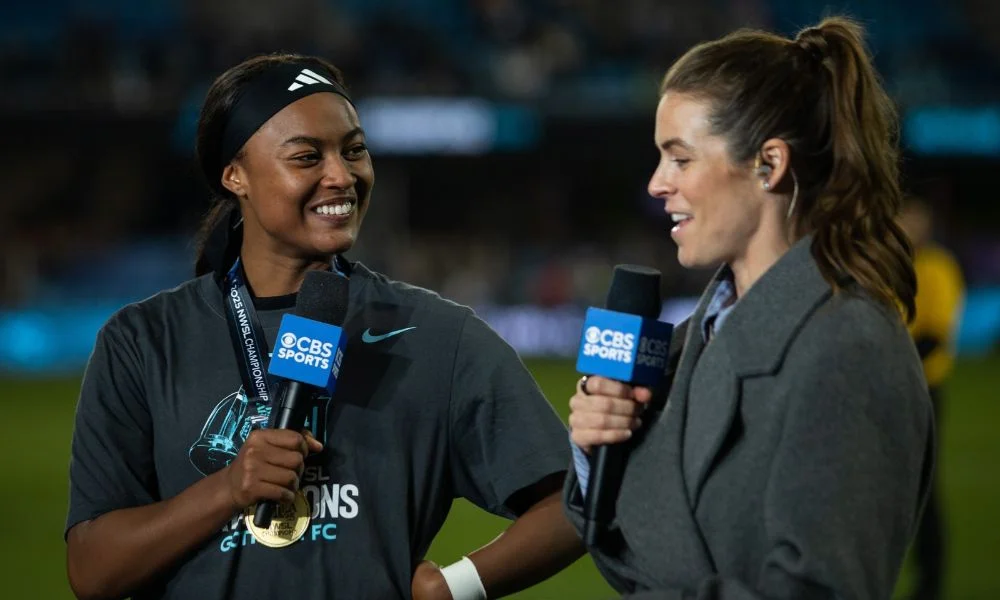
CBS is one of the NWSL’s five media partners for the current cycle, which ends after the 2027 season (Image credit: Getty Images)
From fragmentation to consolidation?
These metrics are crucial as the league and its partner IMG take the NWSL’s domestic broadcast rights to market. Next season is the last to be covered by four-year US$240 million pacts with CBS, ESPN, Amazon Prime Video and Scripps’ Ion.
The NWSL’s current media strategy is designed to cast the net as wide as possible at the expense of consolidation. CBS offers network coverage and a committed audience of soccer fans on Paramount+, ESPN is the most important sports platform in the country, Amazon Prime reaches streaming-first and younger viewers, and Ion has a growing portfolio of women’s sports rights.
Broadcast ratings for the 2026 regular season were a mixed bag. Viewership on ESPN was static and down ten per cent on CBS, while Roku stepped in as a fifth partner after the collapse of Victory+. But the deals have been successful from a revenue, discoverability and audience expansion perspective.
Berman will be confident that the league’s growing audience, broadcaster demand for live sport and the fees commanded by the WNBA will lead to another improved deal – not to mention rising interest in soccer following the World Cup. And, if nothing else, the addition of two new teams in 2028, when the new deals begin, will increase inventory.
“The next 12 months are going to be critically important and foundational for the next stage of growth for the NWSL,” Berman said. “Our biggest growth opportunity is continuing to build and scale audience.
“Our media deal had us really lean into the discoverability of our property. So, we have incredible partners in ESPN, CBS, Amazon and Ion [and Roku]. Our audience is really spread across multiple channels and so we’re really working hard to prioritise key matches and aggregate audience, so that we can really go into this next cycle continuing to build on the strength of the NWSL.”
The league is tight-lipped about whether it will continue with five partners. ESPN’s coverage of the final round of regular season matches, which saw it broadcast all eight games in a single window, showed the benefits of consolidation. The Disney-owned broadcaster has also scheduled some matches in primetime to fill the gap left by MLB, giving the league further reach and prominence.
Meanwhile CBS’ multiplatform coverage of this weekend’s championship game between the Washington Spirit and Kansas City Current will be a timely reminder of the power of network television and give the NWSL a stage to showcase its season finale.
With the final being played at the Spirit’s home ground, Audi Field, the game is set to be the most expensive NWSL title decider to attend by some margin, with demand driving up prices on the secondary market.
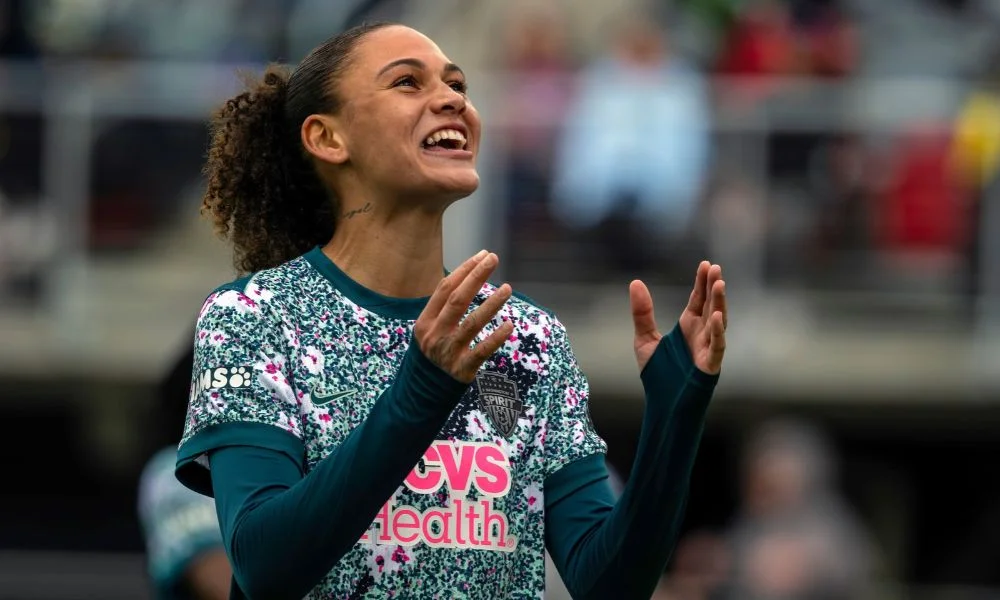
The involvement of star player Trinity Rodman could also attract more casual viewers. The NWSL final drew more than one million viewers in 2025, and another strong rating this year would remind potential suitors that they can get a marquee event as part of their package.
Related posts



The Netflix effect
The next date circled in the calendar is the 2027 Women’s World Cup. Although not being held in the US, the time zone in Brazil is hugely favourable to American audiences. Meanwhile, Netflix’s acquisition of the rights to the tournament in the US and Canada could be transformative in how it is packaged.
Netflix has shown both competence and innovation in its forays into sport thus far, priortising properties that double as cultural events that attract wider audiences.
The streamer’s reach, combined with its ability to make a ten-year-old movie trend on social media simply by placing it on its home screen, could have a major impact on viewership, especially among younger and casual fans who may not even be interested in sport, never mind soccer.
“You will not be surprised to know of the halo [effect] of what happened this summer [at the World Cup],” Hillary Mandel, executive vice president and head of Americas at IMG, which is producing Netflix’s coverage, tells SportsPro.
“Every network’s soccer numbers are up. It’s palpably documentable that America’s interest in looking at soccer [is greater] – I’m not saying they became avid fans, but they’re willing to look.
“If you look at what Netflix have done in the sporting ecosystem … there’s no stopping them. They’ve done well with the National Football League’s Christmas Games and have done a great job with Major League Baseball’s All-Star Game and Field of Dreams game.
“We have an inside seat, and we know how important the Women’s World Cup is going to be on Netflix. The innovation they’re adding and the amount of creative freedom we have – it’s a producer’s dream.”
Olympic ambitions and World Cup dream
Of course, the women’s tournament at the Olympic Games has always carried more significance than its male counterpart, where nations have been restricted by Fifa to selecting just three players over the age of 23 to protect the men’s World Cup.
World soccer’s governing body has suggested it could impose the same requirements on women’s teams in the future, citing player welfare. Yet it also comes as Fifa looks to launch a women’s version of the Club World Cup, whose expanded men’s edition received a lukewarm reception in 2025.
Such moves will likely be met by resistance but, in any case, they will not come into effect in time for Los Angeles 2028, where US success would be one of the highlights of the Games.
But even that is just an appetiser for the 2031 Women’s World Cup. A North American bid is the sole candidate to host the tournament and is widely expected to be confirmed, bringing the event back to American soil for the first time in 28 years. The US last hosted the tournament in 2003, just four months after original hosts China withdrew due to the SARS outbreak.
Women’s soccer has evolved beyond recognition during the four decades since Chastain’s iconic celebration, and the 2031 World Cup will deliver an expanded, more high-profile tournament in a country ready to fall in love with soccer. And it will be on Netflix, too.
For the NWSL, the World Cup represents an unprecedented opportunity to grow the sport at a participation level and to catapult the league’s growth trajectory to new heights.
“The NWSL is preparing to meet that moment,” said Berman. “Investors know that the horizon in front of us is bright, that the foundation of the sport of soccer is strong, and that participation for girls in our country has never been bigger.
“The reason that our commercial partners and our investors are so bullish, and investing literally billions of dollars as we speak, is that these milestones on the horizon … are going to create that watershed moment that’s going to be the tipping point for people to really embrace the soccer part of women’s sports.”
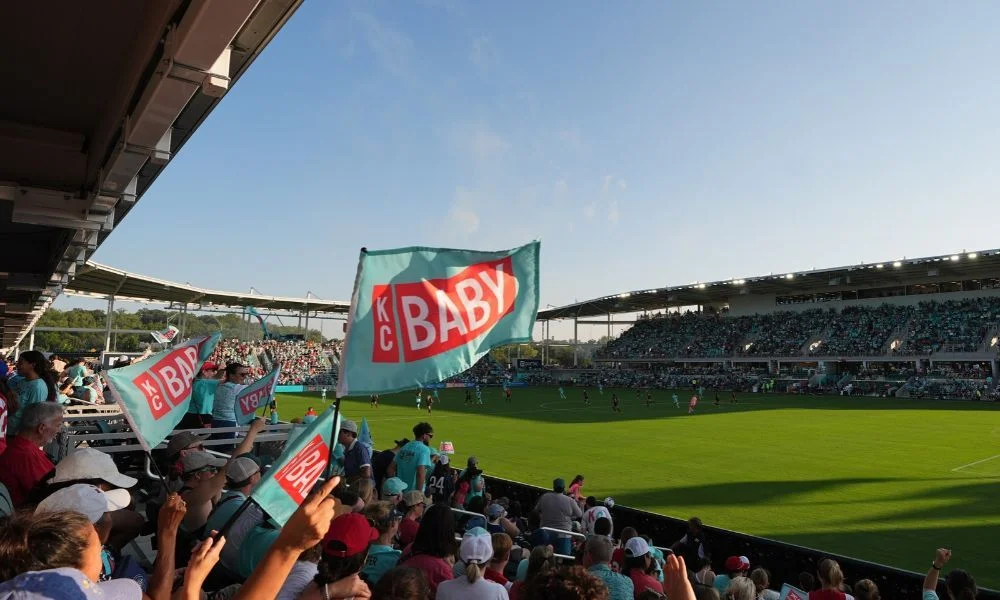
KC Current are the only NWSL side with their own stadium (Image credit: Getty Images)
Infrastructure challenges
One of the biggest legacies, according to Berman, is the ability to invest in training grounds and stadiums.
Several clubs have dedicated training facilities, but Kansas City are the only team that currently play in their own purpose-built stadium – a point referenced in the most recent season of Ted Lasso, which sought to spotlight some of the issues facing the women’s game.
“[This opportunity] is spurring investment in infrastructure,” Berman explained. “In some ways, we are 30 years behind MLS as our infrastructure boom has only just started. By 2028, we’ll have three purpose-built stadiums for our teams, [many of whom] will have state-of-the-art, best in class training facilities [comparable] to any in the other men’s professional leagues in America.
“[NWSL] owners want to be able to attract Fifa and bring events and teams to their markets. All of us who paid attention to the men’s World Cup want to be able to host the Netherlands or the Scots, because of the way they infiltrate the city, have a soccer takeover, and make the event a real cultural moment.”
Berman was speaking before the venue controversies that afflicted the NWSL semi-finals and highlighted why investment in infrastructure is so important for the league if it is to grow.
Defending champions Gotham City FC were forced to move their game with Kansas City from the New York Red Bulls’ Sports Illustrated Stadium due to concerns about the quality of the pitch. The replacement venue, Icahn Stadium, is a 4,500-seater athletics stadium on the poorly connected Randall’s Island in the East River.
Meanwhile, the Spirit were almost forced to switch from their Audi Field home to the Washington Commanders’ Northwest Stadium because their landlords, DC United, had rented the stadium out for a Division III college football game. Only last-minute negotiations prevented another relocation.
The incidents were embarrassing for the league and highlighted how many NWSL teams remain secondary or even tertiary tenants at their home stadiums. An NWSL semi-final held in at a tiny stadium ill-suited to soccer, or played in a half-filled cavernous venue designed for much larger American football crowds, is hardly a good look when courting broadcasters.
But this is a reality check rather than a dealbreaker. Those involved within US soccer and the NWSL believe this unique, once-in-a-generation cycle of events will cement its position as one of the “big two” women’s sports leagues and a fixture of the American sporting diet.
“The WNBA and NWSL are the two biggest women’s leagues in the US and everyone else is [on a lower level],” says Mandell. “The league is delivering, the product is great and owners are investing – they’re not trying to get their money out.
“[Angel City FC owner] Bob Iger doesn’t come into the league just because he has nothing else to do with his bazillions.”