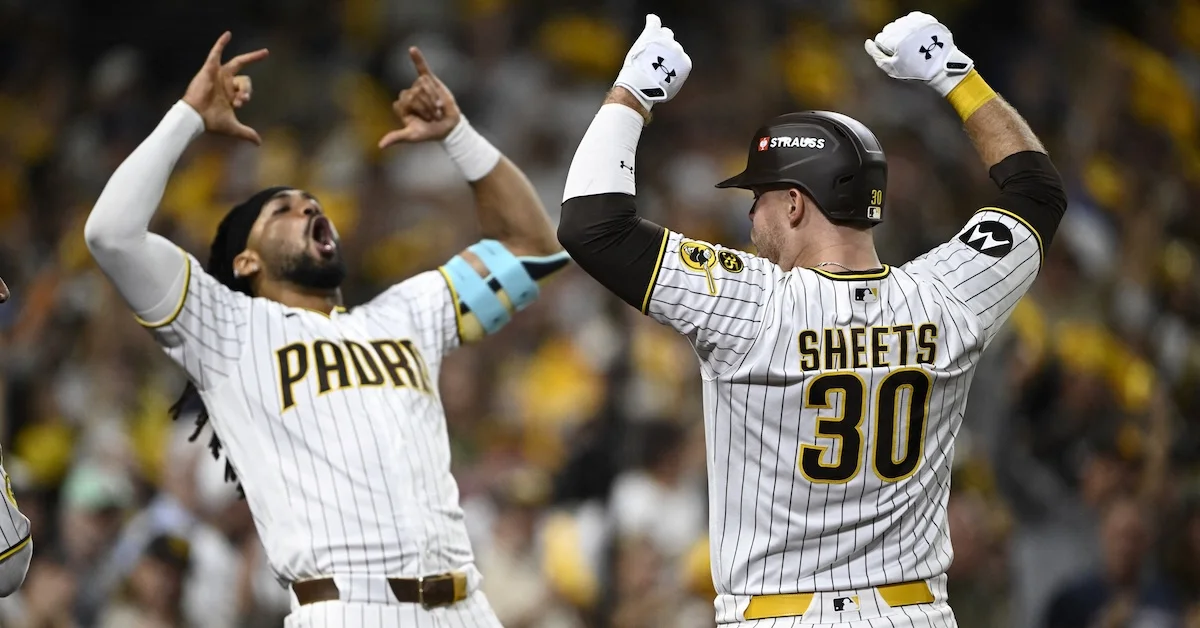
On Wednesday night, the San Diego Padres eliminated the Chicago Cubs from the playoffs with a 4-1 win. A sold-out, frenzied crowd watched the Friars get to Kevin Gausman early, scoring two runs in the second after a double from Ty France, singles from Jackson Merrill and Xander Bogaerts, and a sacrifice fly from Ethan Salas. A two-run homer from pinch-hitter Gavin Sheets in the fourth put San Diego up by three, and from there, the Cubs barely threatened. It was just the latest big moment in a summer full of them for the Padres: A team that saw its playoff odds drop to 7% in late July will now head to Milwaukee for the NLDS.
When you think about this generation of the San Diego Padres, a number of descriptors may spring to mind. “Exciting” works, for all the stars they’ve rostered and playoff runs they’ve made. “Unpredictable” captures the spirit of a front office bold enough to empty the farm year after year, postseason probability be damned. “Competitive” — you heard all those F-bombs during the game last night, yes? — applies, as might “brash,” particularly if you’re from Los Angeles or Phoenix.
But watching this game, I kept thinking about how poised they looked. It’s an unfamiliar feeling watching this group: Fernando Tatis Jr. is many wonderful things, but there’s very little mellow to him or the team he headlines. In an emotional game, though, which is exactly how they looked, and nobody epitomized that more than San Diego’s young catcher.
Salas, as you undoubtedly heard many times on the broadcast, made history by becoming the youngest catcher to ever appear in a postseason contest. You’d have never known it just from watching him. In the loudest game of his life, with a raucous crowd smelling blood and a vibes team playing on a high, the 20-year-old stayed calm. He flipped an Alex Bregman walk into an eventual out with a smart 3-0 challenge in the first. He later resisted the urge to challenge a close pitch in a lower-leverage spot, and deftly pulled borderline pitches into the zone throughout the night. At the plate, Salas had a great approach in his first at-bat. He came up looking to hit something in the air and did so, plating what proved to be the winning run with a sac fly to center.
It wasn’t just Salas, either. Bradgley Rodriguez looked unfazed when he entered in the fourth and inherited a two-on, one-out situation with the go-ahead run on first. He stayed steady when he nicked Carson Kelly with a pitch to load the bases, and had sufficient adrenaline and energy to handle the fifth after working out of that mess in the fourth. Jake Cronenworth kept his cool after taking a dangerous 99-mph fastball in the upper back (we’ll never know if it was deliberate, though the Padres dugout certainly seemed to think so). Adrian Morejon took his time with a soft bouncer, the kind that pitchers can misplay in an exuberant rush to make a play, and calmly started a backbreaking double play in the eighth. Mason Miller remained unflappable when Nico Hoerner delivered Chicago’s only extra base hit of the series, and quickly defused the Cubs’ final rally of the year.
It’s not that the Cubs collapsed, exactly, but they presented a contrast. Pete Crow-Armstrong burned a challenge five pitches into the game, and Kelly lost the other two innings later. Dansby Swanson had a terrible at-bat in the third, when he chased ball four twice and struck out with two men on and nobody out. With a precious runner on and two outs in the fifth, Seiya Suzuki watched a fastball go by over the heart of the plate, then struck out two pitches later on a change in the dirt. The club as a whole looked tense and on edge, and while no one moment ruined the Cubs’ chances, their inability to capitalize in their few opportunities sealed their fate.
Perhaps San Diego’s poise was just an extension of the team’s manager’s. An important subplot in seemingly every playoff game is thinking through when each skipper will pull his starter, and how he’ll manage the reinforcements. Craig Stammen managed the transition brilliantly. The task wasn’t easy, as starter Nick Pivetta has been on a limited pitch count since returning from an elbow flexor strain. Pivetta started well, dotting corners with his entire arsenal. When the Cubs put two runners aboard to start the third, Stammen had Rodriguez warm in case the situation went off the rails but wisely let his starter work through the traffic; his stuff still looked crisp, the game was still early.
He made a different choice in the fourth. After Suzuki lined a sharp single and Ian Happ walked, Hoerner plated Chicago’s only run with a groundball single. Sensing the leverage of the moment, Stammen went to Rodriguez, the first of his big guns. It might not seem like much, but hanging on to let Pivetta get four more outs allowed Stammen to limit the workload of each of the higher-leverage arms in the bullpen. It was no surprise that the one guy who hadn’t tossed more than an inning all year — Jason Adam, recently back from an IL stint — wasn’t asked to do so, even after he made brisk work of the sixth inning. It just looked like Stammen had prepared well for this ballgame, and as a reward, he’ll enter the NLDS with a lightly taxed bullpen.
I didn’t envy Craig Counsell. Managing a rotation you can’t possibly trust not to allow a three-run homer, he used four relievers in Tuesday’s 8-0 loss and doubtlessly knew he’d need to lean on his bullpen again over the rest of the series. He stuck with his starter as the Padres rallied for two runs off Gausman in the second, and stayed the course after a low-stress third. But by the fourth, with only 15 outs until elimination, Counsell could wait no longer after Gausman allowed a ringing double to Bogaerts. He summoned Daniel Palencia, his hardest-throwing reliever.
Whether Counsell went to the right guy or not is up for debate. The trouble with Palencia is that he runs dramatic platoon splits. While he dominates righties with an upper-90s fastball and a tight slider, lefties have hit .340/.441/.640 against him with four bombs in 59 plate appearances this year. It wasn’t an aberration: Lefties have registered a .370 wOBA against Palencia over the course of his career. For context, Kyle Schwarber’s wOBA this year was .368. So, it was a risk for Counsell to bring him in with a man aboard, a lefty up to bat, a second one in the hole, and another on the bench — particularly with lefty bridge options David Peterson and Shota Imanaga on retainer. Perhaps he thought Palencia would overpower the young Salas. Maybe he guessed that Stammen wouldn’t burn his only lefty bat so early in the game.
If so, Counsell went 1-for-2. Salas indeed struck out. But Stammen brought Sheets in to hit for Austin Hays. Sheets got a fastball in the lefty happy spot and didn’t miss:
What a moment for Sheets. The journeyman slugger carried San Diego’s offense for stretches in the first half of the season, not that anyone will know or remember when they glance at his final numbers. After a strong first two months, he hurt his foot and fell into a deep slump in the second half of the season. He went on the IL at the end of August and barely played in September. After all that, to come in cold and drill a 101-mph fastball — the hardest fastball a Padre has ever launched for a homer, per the broadcast — has to be a career-defining moment.
You can sympathize with Counsell. Even if you thought a lefty fit the situation better, you can understand the impulse to throw gas at the bottom of San Diego’s order. Managers and analysts talk all the time about how you can’t let the Machados or the Merrills of the world beat you; the flip side of that is you have to tip your cap when someone like Sheets does it anyway.
Really though: What can a manager be expected to do with a pitching staff that generated 6 WAR all season? How can he nurse a bunch of no. 4 starters through the brute realities of short-series October baseball? What is the use of pushing a bad bullpen’s buttons when the league’s top offense can only score one run in two games? Sometimes the MVP goes hitless in consecutive games and there’s little to say besides “that’s baseball.”
This series was a mismatch, not statistically but in composition. I’m hardly the first to notice, but while the playoff format suits San Diego just fine, it was a horrible fit for the Cubs. They had a staff of pitchers who could eat innings and keep the team in games while their well-balanced offense wore down the opposition. It worked all summer long but crumbled in the high-octane style that October demands. Chicago’s slog through San Diego’s bullpen felt a lot like the All-Star games of recent vintage, with talented hitters ground to bits by a series of guys who can execute plus-plus stuff and need not worry about saving ammo for a second encounter. That the Cubs, the team of the 114 wRC+, will leave town with only eight hits to their name will have Friars fans thinking they can repeat the formula against just about anyone. If the Padres remain as poised as they were on Wednesday, they may well be right.