When is an injury so bad that it requires time off? That depends on all sorts factors. How badly does it hurt? How badly does the team need that player’s production, and how much would playing through it inhibit that production? Would playing through it keep it from healing, exacerbate it, or lead to other injuries? How big is the drop-off between the injured player and whoever would be taking their place?
When is the right time to return from an injury? At any given time in the spring, summer, and fall, we can point to a dozen players whose performance is suffering as they return from an IL stint. Should they have spent more time on the shelf? Nobody knows this for sure, least of all those of us who are watching from the outside. Players see their performance drop off when they return from injuries all the time. Sometimes they returned too early, but sometimes no amount of rest or recuperation would have allowed them to avoid it. Maybe it’s just the unavoidable cost of catching back up to game speed.
Late on the evening of September 25, after the Orioles’ disappointing 2026 season had come to its abrupt, merciful end, Gunnar Henderson revealed to reporters that he’d spent half of it playing through a right wrist injury. “He declined to share the exact details,” wrote The Baltimore Banner’s Andy Kostka, “but said he will not require any surgery.” Even without details, we can draw some obvious inferences. The injury was severe enough to linger for at least three months. That Henderson mentioned it at all indicates that the injury was significant enough to impair his performance, a notion supported by the fact that manager Craig Albernaz “said there were daily check-ins to assess his availability.”
Henderson didn’t want to talk about the injury at all. Multiple reports described him as reluctant to discuss it. He only did so when asked a direct question about whether anything physical had been bothering him this season. “I really don’t like making excuses,” he said after a pause, “because everybody’s banged up at this point in the year. But yeah, I had a little [right] wrist issue going on. But I felt like bat knob changes helped that out. So it was just minor, getting that a little bit better. But like I said, everybody’s banged up at this point in the year. It just sucks that it happened. It is what it is.”
Henderson got the question for two reasons. He played through a shoulder injury in 2025 and only revealed it once the season had ended. “Dove for a ball at some point pretty early in the season,” he said during the Orioles’ Birdland Caravan in January. “Had an impingement and it had some inflammation in there as well. I think some of that stemmed to where I couldn’t plane out as early as I wanted to and just chopped down on the ball.” The second reason is that his performance dropped significantly this year. He still put up 3.6 WAR, but that was the lowest full-season mark of his young career. It represented a drop of 1.2 WAR from last season, which was itself a drop of 3.1 WAR from 2024. Henderson went from a 154 wRC+ two years ago, which made him the ninth-best qualified hitter in baseball, to a 102 wRC+ this year, which made him just a hair above average. WARP, which calculates its own version of deserved offensive production rather than actual offensive production, has seen Henderson as only a bit above average in each of the past two compromised seasons.
For the same reason that it’s facile to credit a hot streak to a hitter’s new batting stance, it’s not a great policy to hear that a player who had a down year was playing through an injury and chalk up all of their underperformance to that injury. But there’s no way of getting around the fact that Henderson has now spent two years playing hurt and playing significantly worse. The way he described the shoulder injury makes it clear that he got an MRI and received a diagnosis that sends players to the IL all the time. In the past six seasons, 11 position players and dozens of pitchers hit the IL with shoulder impingements. In both cases, Henderson described needing to alter his swing in order to compensate for the injury.
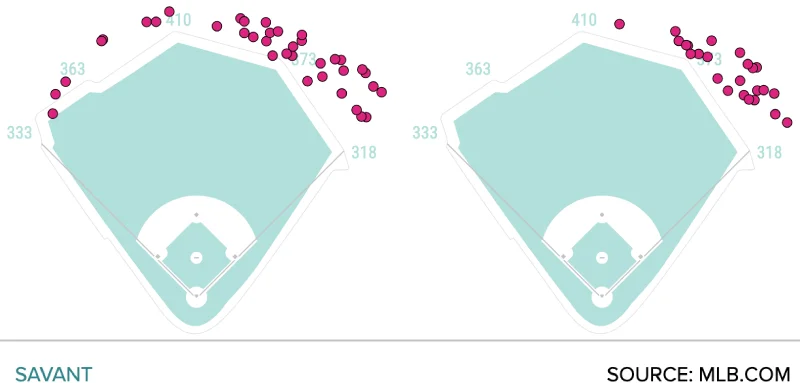
These injuries were enough to turn Henderson from an eight-win player in 2024 to a five-win player in 2025 and a four-win player in 2026. Frankly, its preposterous that he was even that good. From 2024 to 2026, he lost an absurd 3.6 mph of average exit velocity, 2.1 mph of bat speed, and 10.6 percentage points of hard-hit rate. In 2024, Henderson had enough power to spray home runs to all fields. In 2026, even though the Orioles had brought the left field fence back in, he hit just one home run that wasn’t pulled to right field.
This is not a great development for the face of the franchise. And it might remind you very strongly of the player who very recently ceded that title to Henderson. Adley Rutschman started his career with two straight 5.6-WAR seasons, but on June 27, 2024, he took a foul ball to the right hand. (I realize the announcer in the clip below identified the catcher as James McCann, but it was Rutschman.)
Rutschman’s hand was wrapped later that day, and manager Brandon Hyde said there was concern that it would swell up overnight. Rutschman didn’t play the next day, but he never went on the IL or took any extra days off. Both he and the Orioles repeatedly denied the notion that the injury had any effect on his play. But the numbers he put up through the rest of the season spoke for themselves. He lost 0.9 mph of bat speed, 3.1 mph of exit velocity, 14.8 percentage points of hard-hit rate, and his swing got slightly steeper. This graph says it all.
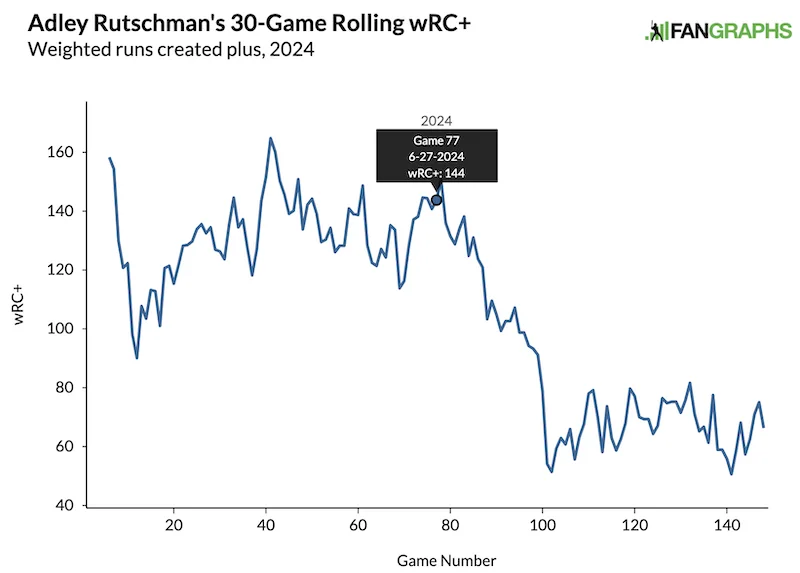
Rutschman’s bat speed jumped back up next spring, but he twice went on the IL with oblique strains in 2025. This year, he’s dealt with a concussion, a hamstring issue, and wrist inflammation. His production at the plate has hovered around the league average ever since June 2024, and of course, the Orioles traded him to the Red Sox at the deadline.
Henderson and Rutschman are far from the first players to keep an injury under wraps or to acknowledge it only at the end of the season. I’m sure other players on the Orioles (and every team) dealt with injuries that went unreported, and I bet some of them played well. But it isn’t a great look for the team’s two most ballyhooed prospects and successful young stars to go through the same song and dance, followed by major drops in performance. In June, another story came out that made it seem unlikely that this was all a coincidence.
Last year, Samuel Basallo signed an eight-year contract extension. This year, Rutschman’s ouster further solidified his status as Baltimore’s catcher of the future. Basallo got off to a hot start, running a 139 wRC+ through the end of May. Then things got awkward. On Friday, June 5, an abdominal injury forced Basallo out of a game against the Blue Jays. He didn’t start on Saturday. On Sunday, June 7, Basallo injured his wrist on a play at the plate.
Basallo has apparently dealt with wrist discomfort for years, but he only learned after an X-ray the next day that it was because of a bony growth in his wrist. The tag play caused it to flare up. “Now, I can treat it the right way,” he told reporters. “Maybe when the season ends, do something to take that off, or I don’t know.” No one outside the organization knows how things went down, but on Monday, the day he learned why his wrist had been plaguing him for years, and one day after he hurt it badly enough to require an X-ray, Basallo obviously informed the team that the wrist was bothering him badly enough that he needed some amount of rest. The Orioles responded by keeping him out of the starting lineup for three days.
Manager Craig Albernaz initially denied that the benching was a disciplinary action, saying, “Just doing what’s best for Sammy. Long season.” The obfuscation made a mess. The story came out in drips and drabs over the next week. A few days later, Albernaz told reporters Basallo was, “learning a lot how to play through being nicked up when everything is checked out and everything is fine.” One day after that, he said, “Another step in his development is knowing how to play through some pain and not being 100% all the time.”
Basallo bristled at the implication, telling reporters, “Everybody plays with pains, everybody plays with injuries and whatever, and I know that because I’ve been through a lot of stuff and it’s just how it is. Some days, I feel fine and I don’t control when they take me out of the game.” Asked about Basallo’s comments, Albernaz replied, “I love that Sammy’s voicing what he’s feeling. He’s voicing it to me too. And it’s one of those things where it’s short-term pain for long-term gain.” In a delightful coda, he added, “I didn’t really mean that to rhyme, but it kind of worked.”
On June 18, unnamed sources inside the Orioles organization levied more charges against Basallo. Ken Rosenthal and Brittany Ghiroli of The Athletic reported that the team “wanted Basallo to engage more with teammates, better connect with pitchers, and acknowledge those who were trying to help him. Small things, in the Orioles’ estimation. But things that needed to be addressed before they developed into larger problems.” One way to interpret the accusation was as a piece of damage control: The team made its young, star catcher look bad in order to make itself look less draconian. The backdrop of all of this back-and-forth was Basallo, presumably not 100%, going 0-for-13 with no walks across seven games.
The message sank in and the Orioles got their wish. In the next several weeks, Basallo played through a shoulder injury that Albernaz called “a lingering thing.” From June 14 to July 19, when the injury finally forced him to the IL for a month, Basallo ran a wRC+ of just 86. He batted just .154 after returning from the IL. Whether or not he was completely healthy at that point, it would be fair to say that injuries wrecked Basallo’s season.
Clearly, I have laid out these three incidents in this order and in this manner to make a specific point. If that’s how the Orioles handle a player who needs the occasional day off to deal with injuries, no wonder these two big stars kept their mouths shut and heads down, performance be damned. The Orioles expect their players to play through minor injuries, and from the outside at least, it appears that their definition of minor includes injuries that can linger for months, can eventually require an extended IL trip, can alter a player’s mechanics, and can very definitely ruin their season.
I realize that I’m making a lot of inferences here, and I’m only connecting three very prominent dots. It’s absolutely true that every ballplayer, and especially every catcher, has to play through bumps and bruises. There is no way to know whether or how much playing through an injury in one season affected Henderson or Rutschman in subsequent seasons. Still, there is a big difference between everyday knocks and injuries that knock multiple ticks off a player’s bat speed and exit velocity. The fact that all three players have seen their performance nosedive after injuries speaks for itself.
I’m going to close with a very, very oversimplified thought experiment. We’re going to look at things actuarially. Henderson averaged 691 plate appearances over the past three seasons. In 2024, he was worth 7.6 WAR per 691 PA. We’re going to assume that’s his true talent level, but just to be conservative, even though he’s 25 and only entering his prime now, we’ll knock it down to an even 7.0. In 2025, he was worth 5.1 WAR per 691, and in 2026, he was worth 3.5. For this exercise, we’re going to credit all his underperformance to the injuries. Again, this is just a thought experiment. So in 2025, his shoulder injury cost him 27% of his production. In 2026, his wrist injury cost him 49%.
Now let’s say that Henderson could have gotten back to 85% health and production by taking some time off and focusing on recovery. Not all the way back to 100%, just 85%. Doing some very simple algebra, in 2024, he could have missed 14% of his games, which works out to 21 games, and still provided more value to the team than he did by staying in the lineup. In 2026, that number is 63 games. Even if Henderson needed well over two months – just to get back to just 85% – it still would have been worth it from a production standpoint to sit him down. Again, this is just a thought experiment, but I have to imagine that every major league team has somebody running some much more comprehensive version of these numbers. And these numbers don’t take a lot into account.
They don’t factor in the possibility that whoever fills in for Henderson at short could contribute positive value. They don’t factor in any long-term physical effects he could suffer from playing through the injury, the ways that playing hurt could mess up his mechanics going forward, the ways it could inhibit his development, or the simple human toll of playing through pain every day, of never getting to feel fully healthy.
Again, I understand that things don’t work this simply. Henderson has spent two seasons playing through injuries, and because he started from such a fantastic place, he’s still been a great player, but he’s also been a shell of his former self. While the list of reasons to let him heal up is long indeed, even the simplest present-value calculation makes a compelling case all on its own. Even if we limit the discussion of Rutschman to 2024, there must have been somebody in the Baltimore front office who looked up at the end of July, noticed that he was batting .122 with a wRC+ of just 45 since that foul ball, and thought about handling the situation differently.
I realize that fans of every team have complaints about how their teams manage or communicate about injuries, but the Orioles spent years suffering through a rebuild for this core. Rutschman is gone. Henderson has spent two years playing at less than his full ability due to injuries. I can’t imagine how Basallo is feeling about his first full season in the majors. You have to think that every young player in the system knows how things went down this June. How many of them will keep quiet about their own minor injuries, and how many of those unaddressed minor injuries will turn into major injuries or keep them from achieving their potential? This seems like the time to consider new approaches.