
A year after a massive deadline sell, the Twins have turned into tepid buyers.
First, on Thursday, they acquired lefty reliever A.J. Minter in a swap with the Mets; then, the next night, they traded with the Orioles for righty starter Dean Kremer. Neither deal is Earth shattering on its own, but together the trades underscore Minnesota’s surprising position with two months left to play in 2026. The team enters Sunday’s rubber match against the Mariners at 56-56, just three games behind the White Sox in the AL Central and tied with the Guardians for the final Wild Card spot.
Minter gives some length to the shallow Twins bullpen. The group has a 4.87 ERA — fifth worst in the majors this year. He joins the team with a 2.35 ERA in 23 innings and figures to see plenty of medium- and high-leverage opportunities, as the lefty counterpart to righties Andrew Morris and Yoendrys Gómez in the late innings.
The 32-year-old Minter is in his 10th year in the majors. He spent the first eight with the Braves, throwing a total of 348 2/3 innings, all in relief. From 2021 to 2023, he was one of the best lefty relievers in the majors, posting a 31.0% strikeout rate, a 7.4% walk rate, and 4.7 WAR across that span. Things went downhill a bit in 2024. He battled a labrum tear, a hip impingement, and a lesion on his femur, cutting his workload to just 34 1/3 innings, though those innings were still pretty effective. He signed with the Mets ahead of 2025, but his season ended in April with a lat strain, which eventually required surgery. That surgery kept him out until late May of this year.
Minter has been different since his return this year. Gone is the great, upper-90s velocity of his prime, and in turn, so is his reliance on the fastball. He now uses a cutter as his primary pitch, mixing in the fastball as a secondary, and sometimes throwing a changeup to righties. The results have been fine. In 23 innings with the Mets this year, Minter has a career-low 21.7% strikeout rate, but also a career-low 2.2% walk rate. It’s the line of someone you might call “crafty,” even if it’s weird to see it coming from someone who was once a great power lefty.
Under this new approach, Minter didn’t allow a run through his first 14 outings of the season, but he’s given up six runs over the last nine — all via the long ball. And so while his 2.35 ERA still resembles his past dominance, his 4.01 FIP suggests he’s trending in the wrong direction.
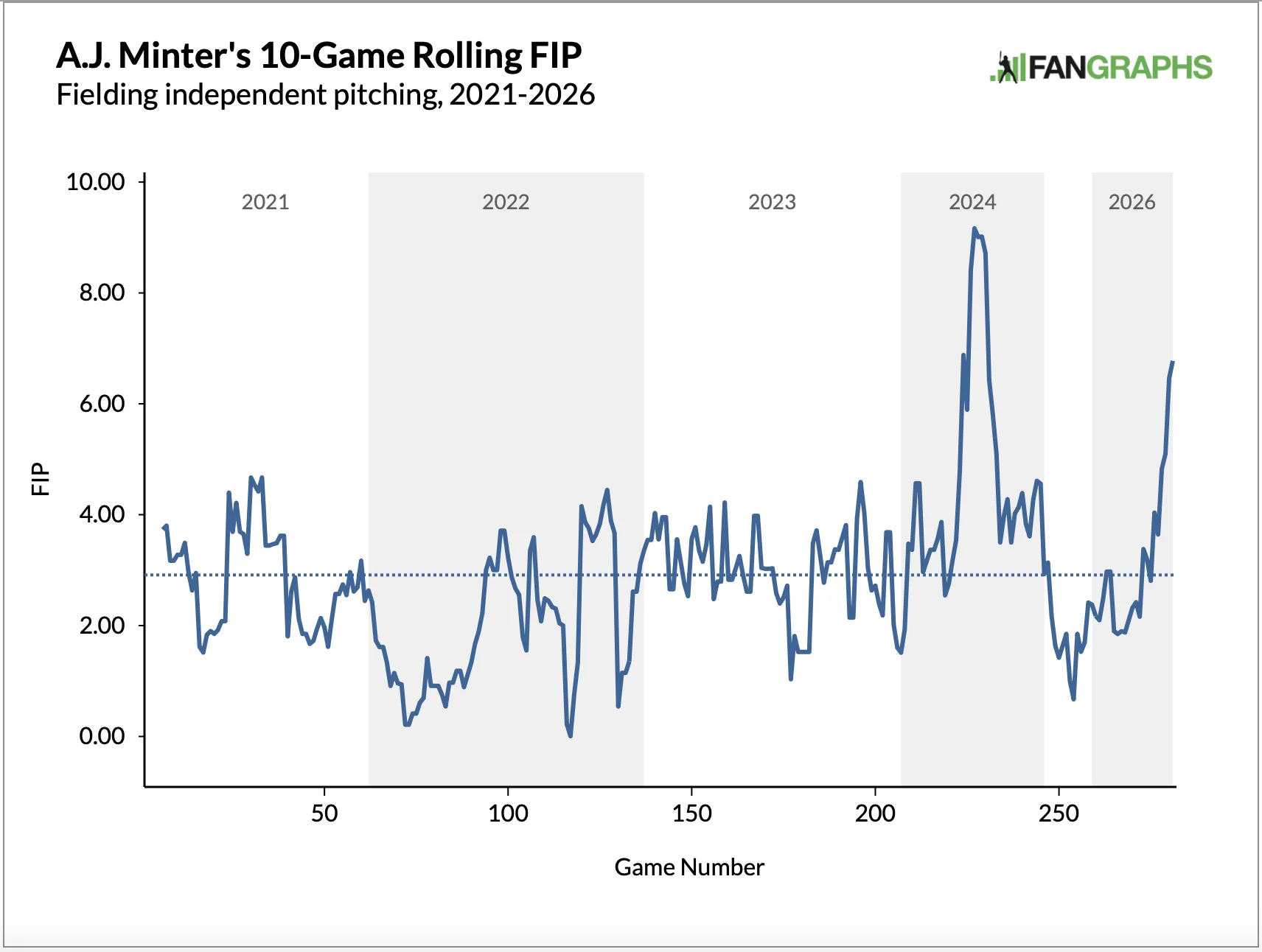
Still, it’s a fine move for a team like the Twins in a tenuous playoff position. He’s now one of their best relief arms, and because of his recent track record, he didn’t command a massive prospect haul, as Minnesota sent Bruin Agbayani and Billy Amick to the Mets in return.
Agbayani, 19, was a sixth-round pick in 2025 and has fewer than 100 professional at-bats. He injured his shoulder in May and has yet to return to the field. Eric Longehagen and James Fegan ranked him 48th on the Twins Top 50 Prospects List for 2026. Though he hasn’t displayed much power, he has shown strong in-zone contact rates while splitting time between second base and shortstop. He’s tall and slender and could conceivably grow into more power. It’s fair to label him a long shot for now.
Amick, 23, is a corner infielder in Double-A. He was a second-round pick out of Tennessee in 2024. He has big power, with 23 homers and a .265 ISO in 379 plate appearances this year. But he was an unranked honorable mention under the “Too Many Strikeouts” portion of the Twins list, and yeah, he has 28.5% strikeout rate this year, cutting his wRC+ to 105.
The Twins also added depth to their rotation by adding Kremer from the Orioles on Friday night. “Depth” is the appropriate word for Kremer. He’s had a fairly steady, unspectacular career so far — one that prompted Baseball Prospectus to name a fifth starter metric after him. He doesn’t get a lot of strikeouts, he doesn’t issue a lot of walks, and his starts often seem to come down to whether or not he gives up a homer. Last year was his best year because he didn’t give up many homers.
This year has been a bit different. He made two starts in April before landing on the injured list with a quad strain. He returned on July 1 and has been the “giving up homers” version of himself. In seven starts, Kremer has a 6.50 ERA and a 6.24 FIP, allowing an even three homers per nine innings. He’s also posted what would be a career best 24.8% strikeout rate, giving him a respectable 17.6% K-BB.
His pitch mix is new in 2026. He’s generally thrown a broad, fairly even mix, with three types of fastballs, a splitter, and a curve. That’s the case again this year, but he’s instead featuring the splitter as his primary pitch. It’s easy to see why: It’s been fantastic, generating whiffs on 42% of swings, while everything else has gotten crushed.
That makes this deal a bit of a high-risk venture. Obviously the Twins don’t think Kremer is going to keep allowing homers at his current rate, and when that normalizes, the rest of his peripherals look strong. Even if the extra strikeouts don’t stick, he still has a track record as a steady backend starter. He helps raise the floor of this rotation for the rest of this year, and he doesn’t reach free agency until after 2027. But if this version of Kremer really is more prone to the long ball, the Twins will continue to lack stability in their rotation.
And that’s not ideal given they did have to send the Orioles a legitimate prospect in return. Jhomnardo Reyes is an 18-year-old outfielder who recently reached A-Ball with tons of physical projection, as Longehagen and Fagen note.
“Reyes was easily the most physically impressive prospect on the Twins’ DSL roster last season at a broad-shouldered 6-foot-3. He had the most exciting long-term physical projection, with room for tonnage, but he struck out at a scary rate. He has started to make good on that projection and has not only hit the baseball harder — at 110 mph, his max exit is up three ticks compared to last year, his EV90 is up seven ticks to 108 mph, and his hard-hit rate is up 18 percentage points to 50% — but his added strength has seemingly helped him shorten up.”
Reyes won’t make it to the majors for quite some time, if ever. But these are the kinds of deadline deals that several years down the line can look unfortunate, especially for a team, again, with tenuous playoff chances.
That’s really the best way to describe it for the Twins. They have a .500 record and are one of the “luckiest” teams in the majors this year given their Pythagorean and BaseRuns records. They don’t really do anything well. The strength of their roster is the lineup, but other than a scorching hot June, they haven’t hit well. They’ve struggled on the bases and in the field, and Minter and Kremer are merely depth for a pitching staff without much upside.
Still, the American League is bad, and the Twins aren’t alone in having major question marks. Their Playoff Odds are about 1-in-3, which is right there with much of the field. If the bats get hot again, they very well could stay in the race until the end. And that’s not nothing given last deadline saw them sell off nearly half their active roster. A year after what looked like the beginning of a years-long rebuild, the Twins are trading for veteran depth. Such is the state of the American League.